
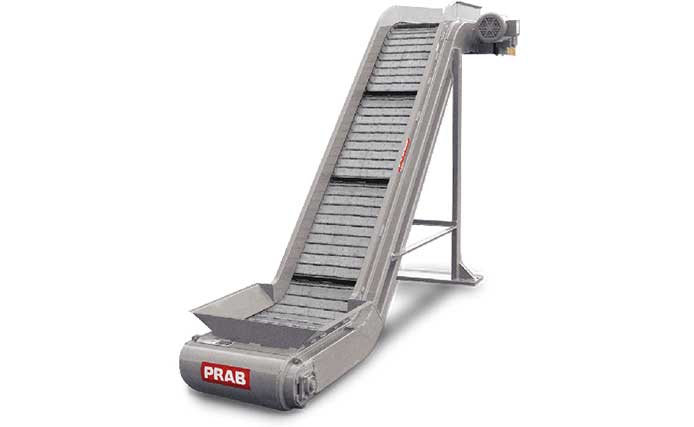


Hinged steel belt conveyors move sharp, bushy, wet, or dry metal scrap and chips from the machine to the hopper, shift after shift.
Health & Safety: Fewer forklift trips and less hand contact with sharp scrap.
Low Maintenance: Known for dependable service and a long lifespan with minimal upkeep.
Heavy-Duty: Built for the sharp, heavy, hot scrap metalworking products.
Value: Scrap moves on its own, so operators stay on production.
A steel belt conveyor, also called a hinged steel belt conveyor, hinged belt conveyor, or metal belt conveyor, uses linked steel pans that ride on heavy side chains. It carries metal scrap from the machine to a hopper, bin, or processing system. It can run flat, climb an incline, or do both. It works as a chip conveyor on CNC machines and as a scrap conveyor under stamping presses. It handles sharp, heavy, bushy, wet, or dry scrap that would tear up a rubber belt.
A PRAB steel belt conveyor moves scrap away from your machines so your operators can keep making parts. It is the most versatile metal scrap conveyor we build. It handles the hard stuff. Sharp stampings, bushy turnings, die scrap, and heavy chunks all ride the same belt, wet or dry.
These conveyors are built to last. One PRAB unit, known as Old Faithful, ran for 48 years before it retired.
Machining, die casting, stamping, forging, laser cutting, and finished parts handling.
On CNC machines and transfer lines, a steel belt chip conveyor pulls chips and turnings out of the machine and lifts them into a hopper. Bushy, stringy turnings that tangle in other conveyors ride flat on a hinged belt. Perforated belts let coolant drain back to the sump instead of leaving with the chips.
Under a stamping press, a steel belt conveyor catches slugs, skeleton, and trim scrap as it falls and carries it out from under the press. Impact plates protect the belt from heavy drops. For thin, oily stamping scrap that clings to belts, a pivot belt conveyor is often the better fit.
Read more: critical design elements for under-press steel belt conveyors.
PRAB builds and services steel belt conveyors in Kalamazoo, Michigan, for North American plants. Our team in Opole, Poland, builds and services them for customers in Europe and beyond.
The right conveyor depends on your scrap. Here is where a steel belt fits and when another type works better.
| Conveyor type | Best for |
|---|---|
| Steel belt conveyor | Mixed, sharp, heavy, hot, or abrasive scrap, wet or dry. Flat runs and inclines. |
| Drag chain conveyor | Highly abrasive material like cast iron. Enclosed designs help control dust. |
| Magnetic conveyor | Ferrous chips and fines, moved without carryover. Will not hold aluminum or other non-ferrous scrap. |
| Oscillating conveyor | Gentle horizontal transfer of chips and scrap, often machine-side or in a pit. |
| Pivot belt conveyor | Thin, oily, or sticky stamping scrap that clings to standard belts. |
Not sure which fits? Try the Find Your Conveyor tool, or send us a sample for free materials testing.
| Spec | Choices |
|---|---|
| Belt pitch | 2.5″, 4″, 6″, or 9″ |
| Layout | Straight, L-style, or Z-style |
| End shape | Round, square, or open |
| Belt surface | Smooth, dimpled, or perforated |
| Drive position | Above, below, or on the side |
| Frame | Open or closed |
Every PRAB hinged steel belt conveyor is built on a heavy-duty side chain and die-formed steel belt, so it keeps running with little upkeep.
| Belt type | Best for |
|---|---|
| Hinged steel belt | The standard choice for most scrap. Comes smooth, dimpled, or perforated. |
| Beaded apron pan | High heat and heavy wear. |
| Pivot belt (PRAB exclusive) | Thin chips and sticky scrap that would ride back around on other belts. |
| Combination belt | The grip of a rubber belt with the strength of a steel belt. |
| Mesh belt | Cooling hot parts and letting coolant flow through. |
| Bucket belt Z-pan | Free-flowing material up a steep incline. |

Picks up scrap low, climbs, then runs flat again to release at a set height. Good for large containers and overhead layouts.


A low flat section, then a climb. A low-cost way to feed smaller containers.
A single flat or inclined run.
Scrap collects in the low flat section of the conveyor. The belt then lifts it and releases it at the height you choose. Impact plates protect the belt from heavy drops. Chain oilers keep the chain and rollers moving freely.
A beaded pan steel belt conveyor built for high heat and heavy wear.
A beaded pan steel belt conveyor built for high heat and heavy wear.

PRAB’s steel belt conveyor transports copper chips to downstream processing equipment.
PRAB’s steel belt conveyor transports steel chips to downstream processing equipment.
Scrap collects in the low flat section of the conveyor. The belt then lifts it and releases it at the height you choose. Impact plates protect the belt from heavy drops. Chain oilers keep the chain and rollers moving freely.
Product Brochures
Product Brochure: Steel Belt Conveyor
Product Brochure: Beaded Pan Conveyor
Application Review
Application Review: A Die Cast Company Improves Melting Process and Cuts Operating Expenses
Application Review: Automotive Powertrain Manufacturer Sees Results BEFORE Installation of PRAB Wringer and Conveyor Through PRAB’s ‘Prove It Before You Use It’ Approach
Application Review: Full-Service Recycler Increases Profits with Orbital Load-Out System
Application Review: Mobile Conveyor Helps a High-Volume Stamping Operation Improve Production and Increase Safety
Case Studies
Case Study: Aerospace Components Manufacturer Turns Its Waste Stream into a Revenue Stream
Case Study: Cashing in Your Chips
Case Study: C&A Tool Increases Profitability, Maintains Clean Facility With Chip Processing System
Case Study: Martin-Baker Turns Scrap Metal and Fluid into Revenue Stream
Case Study: Metal Stamping Company Implements Successful Expansion Project in Partnership with PRAB Conveyors
Case Study: Metalworking Company Finds Increased Asset Utilization by Focusing on Scrap Management
Technical Brief
Technical Brief: Critical Design Elements for Maximizing the Life of Under Press Steel Belt Conveyors
White Paper
White Paper: Avoiding Accidents, Injuries & Illnesses In Metalworking Operations
White Paper: Reallocating Labor in the Metalworking Industry
Other Downloadable Content
Conveyor Solutions
Die Cast Scrap Conveyor Systems
Stamping Scrap Conveyors & Systems
PRAB Builds Equipment for the Toughest Jobs in Manufacturing and Metalworking
Conveyor Performance White Paper
The Challenge Kalamazoo, Mich., February, 2015 – Featured in Modern Machine Shop Magazine. The more chips a company cuts, the better. But once the output reaches a certain volume, it may be time to look beyond traditional disposal methods toward more efficient systems. New chip processing equipment, linked with coolant filtration systems, can raise the value of […]
CHALLENGE A machining supplier needs an automated chip processing system and Coolant recycling for metal turning and chip management, while simultaneously capturing expensive cutting fluids for reuse. CUSTOMER C&A Tool Engineering, Inc. www.catool.com INDUSTRY Machining PRODUCT Diagonal-Shaft Wringer Steel Belt Conveyor Screw Conveyor Tramp Metal Separator Vertical Axis Crushers C&A Tool Engineering, Inc. is a premier international supplier […]
CHALLENGE Aerospace manufacturer needs a chip and fluid processing system to keep up with its machining demands by reducing the volume of metal turnings and to recover expensive cutting fluids for reuse. The goal was to transform their metal scrap and fluid into a viable source of revenue. CUSTOMER Martin-Baker INDUSTRY Aerospace PRODUCTS Dualpak™ Briquetter, Steel Belt […]
A metal scrap conveyor is a system used in manufacturing to transport metal chips, turnings, swarf, and other waste for recycling or disposal. Common types include steel belt, oscillating, drag chain, magnetic, pneumatic, and specialty conveyors; each is chosen based on scrap size, abrasiveness, coolant content, or temperature. These systems improve efficiency, safety, and the value of metal scrap while preventing downtime.
PRAB metal scrap conveyors are engineered for 30+ years of continuous operation—with documented installations exceeding 40 years. Systems handle up to 2,000 lb/hr of scrap and integrate seamlessly with metal chip processing and coolant recycling systems. Known for their low-maintenance and durable design, PRAB metal handling systems are trusted by automotive, aerospace, die-casting, CNC, and heavy manufacturing plants worldwide.
Resources:
Rule of thumb:

 (800) 968-7722
 (800) 493-3462