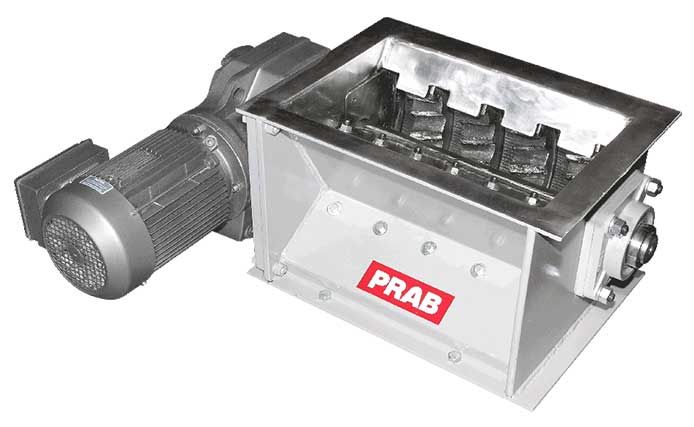





Continuous low-volume metal scrap reduction at the source. Metal crushers are an economical solution for processing stringy, bulky turnings into flowable chips. This piece can be integrated into existing equipment or be free-standing.
PRAB’s automated scrap removal systems are designed for volume reduction of metal turnings. The comprehensive focus on chip processing provides metalworking companies with an automated, safe, and cost-effective way to process all kinds of metal scrap. The first step in this operation is to create flowable chips from metal turnings using scrap-handling equipment.
The Horizontal Axis Crusher processes low volumes of stringy and bulky metal turnings. This scrap metal recycling equipment is typically mounted on a stand or a heavy-duty cart that fits over the conveyor discharge from the machining center.
Advantages of the PRAB Horizontal Axis Crusher include:

A horizontal-axis crusher is metal scrap processing equipment that reduces stringy, bulky metal turnings into small, flowable chips at the point of generation. Two rotating cutting blades on a horizontal shaft self-feed the material and break it down, reducing scrap volume by up to 12x. PRAB’s unit is compact enough to mount on a stand or heavy-duty cart at the discharge of a machining center, either integrated into existing equipment or free-standing.
Use a horizontal-axis crusher when you are processing low volumes of stringy or bulky turnings at a single machine or cell and want an economical, low-horsepower, quiet solution with a small footprint. Choose a metal turnings shredder when handling higher volumes or tougher, heavier scrap that requires more aggressive size reduction, typically at a centralized collection point rather than at the machine. In short, the crusher is the at-the-source option for lighter, lower-volume duty; the shredder is the heavier-duty option built for larger throughput.
A horizontal axis crusher processes stringy and bulky metal turnings, including the long, nested turnings produced by steel and other machined metals. It converts these difficult-to-handle turnings into uniform, flowable chips that move easily through downstream conveyors, wringers, and chip processing systems. Capacity varies by material type, so output figures should be confirmed for a specific application.
A PRAB horizontal axis crusher reduces metal turnings volume by up to 12x. That reduction lowers transportation and haul-away costs because compacted, flowable chips take up far less space than loose turnings, and it also reduces housekeeping, production-floor downtime, and increases CNC uptime.
A horizontal-axis crusher is installed at the source, directly at the machining center, typically mounted on a stand or heavy-duty cart at the conveyor discharge. This at-the-machine placement process turnings as they are generated, which is what allows it to reduce volume and improve housekeeping before scrap ever reaches a central collection area.
A horizontal axis crusher does not separate fluid on its own; its job is to turn stringy turnings into flowable chips. Fluid recovery occurs when the crusher is integrated with fluid reclamation or chip-processing equipment, such as a wringer or filtration system, which is an available option. Creating flowable chips is the necessary first step for efficient downstream coolant recovery.
A PRAB horizontal-axis crusher has a nominal capacity of 100 to 300 lbs/hr (45 to 177 kg/hr), runs on a 2 HP motor, occupies roughly a 3 ft by 3 ft footprint, and weighs about 550 lbs (249 kg). It is available in multiple sizes to match application requirements, with optional feed hoppers based on output, and it is covered by PRAB’s one-year warranty.
A horizontal-axis crusher improves safety by automating scrap handling that operators would otherwise handle by hand. Processing long, sharp turnings into flowable chips at the machine reduces the manual handling of jagged scrap and lowers the risk of hand injuries, while a motor and gearbox with overload protection and a fixed, abrasion-resistant discharge screen support safe, dependable operation.
Features
Options
|
Nominal Capacity* |
Dimensions |
Motor Power |
Net Weight |
|
100-300 lbs/hr |
3 ft X 3 ft |
2 HP |
550 lbs |
*Capacity varies with different types of material. For accurate output figures, please contact us.
*Feed hoppers are optional based on output.
*Available in multiple sizes to fit your application requirements.
PRAB’s Horizontal Axis Crusher Reduces Steel Turnings to Flowable Chips
PRAB’s horizontal axis crusher reduces steel turnings into flowable chips directly at the machining cell.
PRAB Steel Turnings – Horizontal Axis Crusher
PRAB’s horizontal axis crusher reduces the volume of long pieces of steel turnings into flowable chips.
Product Brochures
Product Brochure: Horizontal Axis Crushers
Case Studies
Case Study: Ingersoll Tillage Enhances Workplace Safety and Increases Scrap Value with PRAB’s Horizontal Axis Crusher
Case Study: Machining Company Achieves Considerable Cost, Space and Labor Savings with a PRAB Crusher/Wringer System
White Paper
White Paper: 8 Problem Areas Affecting Metalworking Operation Profitability
White Paper: Avoiding Accidents, Injuries & Illnesses In Metalworking Operations
White Paper: Green Engineering
White Paper: Reducing Haul-Away Costs in Metalworking Operations
Other Downloadable Content
PRAB Chip Processing Systems All Product Brochure
PRAB Builds Equipment for the Toughest Jobs in Manufacturing and Metalworking
According to the Aerospace Industries Association, few if any industries have done a better job of improving environmental performance over the last several decades than the aerospace industry. The AIA states that today’s aircraft and engines are considerably more efficient than those manufactured just 20 or 30 years ago, which has dramatically decreased fuel usage and harmful emissions. Additionally, […]
Download Proven To Reduce Metal Scrap Volume By As Much As 90% Documented Results Achieved by PRAB Customers: INCREASED REVENUE“We get $0.17 per pound more for our briquetted material over loose chips.”– Jack Rovan, Martin-Baker Plant Manufacturing Manager IMPROVED EFFICIENCY & SAFETY“PRAB has truly helped us get more money for our waste metal and improve our […]
Download The PRAB Horizontal Axis Crusher is proven to Reduce Scrap Value Up to 90% and reduce scrap volume up to 12X The PRAB Horizontal Axis Crusher (HAC) processes low volumes of stringy, bulky metal turnings into flowable, shovel-grade chips at the point of generation. Engineered for on-site maintenance with all wear parts being easily replaceable, including rotating […]

 (800) 968-7722
 (800) 493-3462