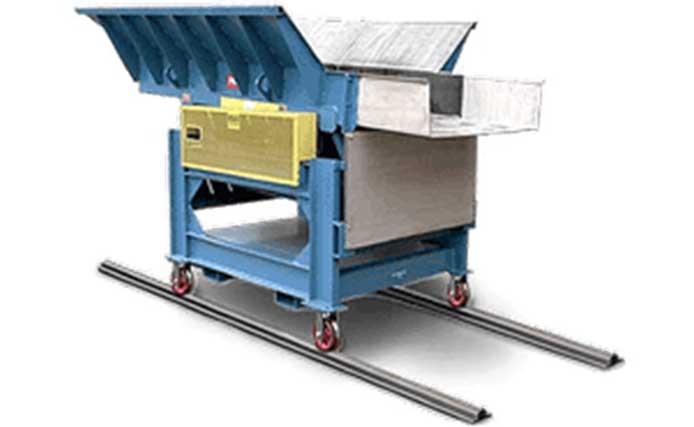





Meter feed directly to scrap metal furnace.
Meter feed abrasive die scrap, casting metal, and other materials directly to the melting furnace.
PRAB’s furnace feeder scrap removal systems allow you to meter feed abrasive die scrap casting metal and other materials directly to the scrap metal furnace.
Advantage of a PRAB Furnace Feeders include:
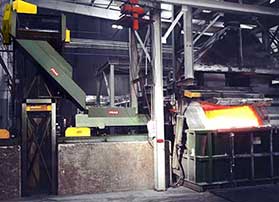
PRAB Furnace Feeder System
PRAB Furnace Feeder System provides positive feeding of die cast scrap into a furnace. The system uses a steel belt conveyor and an Oscillating Conveyor.
Product Brochures
Product Brochure: Furnace Feeder
Application Review
Application Review: A Die Cast Company Improves Melting Process and Cuts Operating Expenses
Other Downloadable Content
Conveyor Solutions
Die Cast Scrap Conveyor Systems
PRAB Builds Equipment for the Toughest Jobs in Manufacturing and Metalworking
Conveyor Performance White Paper
THE CHALLENGE: Improving the Aluminum Re-Melting Process A die-casting company in the Midwest contracts with automotive and other industrial OEM companies to design and manufacture die-cast parts from Aluminum, Zinc, and Plastic. The die caster recognized the need to improve the efficiency of their Aluminum remelting processes. The die-cast industry as a whole has […]
Proven to Raise Productivity Up To 60%Documented Results Achieved by PRAB Customers Enhanced Productivity Downtime Before PRAB: 3-4 hours Downtime After PRAB: 2 minutes Safer Workplace “Our process of disposing metal scrap has become more ergonomic and safer.” – Jack Rovan, Martin-Baker Long Lasting Equipment: Conveyors Still Operating in the Field […]
Proven To Raise Productivity Up To 60% Documented Results Achieved by PRAB Customers Decreased Downtime Downtime Before PRAB: 3-4 hoursDowntime After PRAB: 2 minutes Safer Workplace “Our process of disposing metal scrap has become more ergonomic and safer.” – Jack Rovan, Martin-Baker Long Lasting Equipment: Conveyors Still Operating in the Field After 57 Years PRAB Conveyors […]
A metal scrap conveyor is a system used in manufacturing to transport metal chips, turnings, swarf, and other waste for recycling or disposal. Common types include steel belt, oscillating, drag chain, magnetic, pneumatic, and specialty conveyors—each chosen based on scrap size, abrasiveness, coolant content, or temperature. These systems improve efficiency, safety, and the value of metal scrap while preventing downtime.
PRAB metal scrap conveyors are engineered for 30+ years of continuous operation—with documented installations exceeding 40 years. Systems handle up to 2,000 lb/hr of scrap and integrate seamlessly with metal chip processing and coolant recycling systems. Known for their low maintenance and durability, PRAB metal handling systems are trusted by automotive, aerospace, die-casting, CNC, and heavy manufacturing plants worldwide.
Resources:
Durable metal scrap conveyors are engineered with abrasion-resistant components, heavy-gauge steel, sealed bearings, and bolt-free flight connections.
Metal scrap conveyor durability in harsh metalworking environments is required to reduce downtime and extend lifespan. Factors like temperature resistance, magnetic properties, incline, and maintenance requirements should be considered.
PRAB incorporates AR-steel wear bars, NEMA-rated motors, and replaceable side wings in its steel belt and drag conveyors. In high-volume machining environments, these design choices have doubled belt life compared to light-duty competitor units. Documented cases show PRAB conveyors requiring 50% fewer unscheduled maintenance interventions annually.
Resources:
Conveyors integrate with metal chip processing and coolant recycling systems by automatically moving metal chips and swarf to downstream equipment such as crushers, wringers, centrifuges, or briquetters. This seamless flow allows for fluid reclamation, cleaner scrap handling, and more efficient scrap load-out.
PRAB engineers metal scrap conveyors to function as part of complete chip and fluid management cells, with built-in integration points for crushers, wringers, and fluid recycling systems. In one aerospace components facility, a full PRAB system increased scrap value by 25% and recovered more than 90% of machining fluids, saving over $120,000 annually in coolant purchases.
Metal scrap conveyors eliminate manual scrap handling, reduce forklift traffic, spill risks, and operator injuries. They improve workplace safety by keeping floors cleaner, reducing slip hazards, and improving workflow efficiency.
PRAB conveyor systems have helped facilities cut forklift scrap transport by up to 80%, reducing accident risk and freeing floor space for production. In one metal stamping plant, installation of an in-floor trough conveyor system reduced housekeeping labor by 15 hours per week, improving both safety and productivity metrics.
Resources:
Choose a metal scrap conveyor supplier that offers documented performance guarantees, preventive maintenance programs, and long-term parts availability.
Every PRAB conveyor is backed by the Performantee® Guarantee—verifying ROI through lab testing and throughput verification before shipment. PRAB also offers a Managed Maintenance Program, which, in one machining operation, reduced unplanned downtime by 40% over 18 months through scheduled inspections, OEM parts, and 24/7 technical support.
Resources:
 Consider scrap size (fine chips vs bushy turnings), material (aluminium vs steel vs cast iron), coolant content (wet vs dry), and elevation/incline.
PRAB’s engineering teams conduct scrap and coolant testing before specification, ensuring conveyors meet throughput and wear requirements. In one stamping plant, a PRAB pivot belt conveyor reduced carryover delays by 35% and improved scrap evacuation speed by 28%. This data-driven selection process extends belt life and minimizes energy use.
Resources:
Rule of thumb:
A magnetic conveyor and a magnetic separator both use magnets to handle ferrous material, but they perform opposite functions. A magnetic conveyor is a material handling device that transports solid ferrous chips and parts. A magnetic separator is a fluid filtration device that pulls ferrous fines out of coolant. One moves metal. The other cleans fluid.
| Magnetic Conveyor | Magnetic Separator | |
| Primary job | Transports solid ferrous scrap | Removes ferrous fines from fluid |
| Acts on | Chips, slugs, turnings, small parts | Coolant or cutting oil |
| Category | Material handling and conveying | Fluid filtration |
| Typical position | Machine side, feeding downstream processing | In the coolant loop, often as a pre-filter |
| Output | Scrap delivered to a bin or processor | Cleaner fluid returned to the process |
The difference is what they act on. A magnetic conveyor transports solid ferrous scrap such as chips, stamping slugs, turnings, and small parts from the machine to downstream equipment or a container. A magnetic separator removes suspended ferrous fines and sludge from a fluid stream so the coolant or oil runs cleaner. A conveyor is used for material handling. A separator is fluid filtration.
A magnetic conveyor moves ferrous material cleanly and without carryover. PRAB uses a beltless slide design, with permanent magnets on a chain beneath a stationary stainless steel slider bed that grip the material and carry it to the release point, including up inclines. It is the right tool when the goal is to reliably move fine or thin ferrous scrap to a wringer, centrifuge, briquetter, or bin. See the full magnetic conveyor product page for models and configurations.
A magnetic separator removes ferrous contaminants from liquid. PRAB separators use a rotating drum fitted with ferrite or rare-earth magnets. As contaminated coolant or cutting oil flows across the drum, ferrous particles are captured and carried out of the fluid stream, and the cleaned fluid continues on. It is commonly used in grinding, honing, and gear cutting, and often runs as a pre-filter ahead of other fluid filtration equipment. PRAB ferrite models remove up to 97 percent of ferrous particles larger than 40 microns, and rare-earth models capture down to 15 microns, per PRAB published specifications.
Choose based on the problem you are solving. If solid ferrous chips are piling up at the machine and need to be moved away cleanly, you need a magnetic conveyor. If your coolant is loaded with fine ferrous particles that hurt tool life and surface finish, you need a magnetic separator. Many operations end up using both because moving the scrap and cleaning the fluid are two separate goals.
Yes, and they often work as a pair. A magnetic conveyor handles the solid scrap leaving the machine, while a magnetic separator keeps the coolant clean in the same cell. Both feed the larger goal of recovering fluid and scrap value, which is where coolant recycling systems complete the loop.
No. A magnetic conveyor is a conveying and material handling device, not a filtration device. It can help the coolant drain off the scrap as it moves, which reduces fluid carried away with the chips, but it does not filter the fluid itself. Removing particles from the fluid is the job of a magnetic separator or other fluid filtration equipment.
Both use permanent magnets, but are configured differently. A PRAB magnetic conveyor uses ceramic magnets, with rare-earth available, mounted on a moving chain under a fixed slider bed to grip and carry solid scrap. A PRAB magnetic separator uses ferrite or rare-earth magnets inside a rotating drum to attract fine particles out of flowing fluid. The conveyor holds and transports. The separator attracts and extracts.
For non-ferrous or mixed scrap that a magnet cannot hold, a steel belt conveyor is the appropriate transport choice instead of a magnetic conveyor.
Start by separating the two questions: how do I move the scrap, and how do I keep the fluid clean. For the scrap side, use PRAB’s conveyor selection tool or browse the full conveyor lineup. For the fluid side, the surest path is to test your actual coolant. PRAB offers free fluid testing for separator sizing and free materials testing for conveyor selection, so the equipment is matched to your real material rather than a generic profile.
Not sure which one fits, or whether you need both? Contact an expert at PRAB, or explore magnetic conveyors and magnetic separators to compare them side by side.

 (800) 968-7722
 (800) 493-3462