Every PRAB system — conveyor, chip processor, coolant recycler, and industrial water treatment — is built on the same automation backbone: PLC controls, HMI operator interfaces, and IIoT sensors, engineered by PRAB’s KMC Global Controls & Automation division. That means automatic coolant concentration control, automated tramp oil removal cycles, and scrap tracking that logs to your ERP or MES system on its own. Systems are custom-engineered for individual production cells and commissioned fast enough to minimize downtime on a retrofit.
Learn how PLC, HMI, and IIoT controls automate scrap and coolant handling →
PRAB and its sister company, KMC Global Controls & Automation, provide UL-listed industrial controls and automation. Including control panels, panel design, and custom programming for virtually all industrial equipment applications.
Elevate your manufacturing processes with our advanced industrial control panels, consulting services, and expert PLC, HMI, and IIoT programming tailored for any industry. Whether optimizing existing systems, replacing outdated panels, or starting a new project, we provide the cutting-edge control equipment and engineering expertise you need.

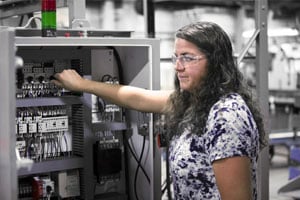
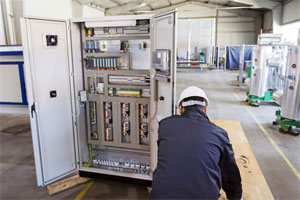

UL 508A is the UL safety standard specifically written for industrial control panels — it governs how a panel is constructed, wired, and rated so it can be legally installed and operated in an industrial facility. A UL 508A listed panel has been built to that standard by a certified panel shop and carries the UL mark verifying it. For plant engineers and safety managers, that listing isn’t a formality: many facilities, insurers, and jurisdictions require it before a panel can be put into service. KMC Global Controls & Automation is a UL 508A certified industrial control panel manufacturer, so every panel that leaves the shop is built to pass inspection the first time.
Custom industrial control panel design starts with the application, not a catalog part number. KMC’s in-house team handles the full process: electrical schematic design, panel layout, component sourcing, and complete in-house fabrication — meaning a panel isn’t assembled from outsourced sub-parts, but built start to finish under one roof with one team accountable for the result. This matters most for OEM manufacturers who need a repeatable, documented panel design across multiple machine builds, and for end users retrofitting a control panel onto equipment it wasn’t originally designed for.
PLC programming is what turns a wired panel into an actual automated system — the logic that sequences machine operation, manages fault detection, and coordinates the panel with everything connected to it. KMC provides both factory and on-site PLC programming, whether that’s building a new program from a blank slate, modifying an existing program to support a process change, or troubleshooting a program that’s no longer doing what the original integrator intended. Programming is done on major industrial PLC platforms, with documentation delivered so your team isn’t dependent on a single programmer’s memory to maintain the system later.
An HMI (human-machine interface) is the touchscreen or display an operator actually interacts with — run status, fault codes, manual overrides, and production data, presented in a way that doesn’t require reading raw PLC logic to understand. Advanced HMI design means more than moving buttons onto a screen: it means structuring the interface so operators can diagnose a problem in seconds during a live production stoppage, not minutes. KMC designs and programs HMI systems as part of a new panel build or as a standalone upgrade to an existing control system.
Individual panels and PLCs are only part of the picture once a facility is running more than one automated system. SCADA integration connects multiple control panels, PLCs, and HMIs into a single supervisory system, so plant engineers can monitor and manage automated processes across a line — or an entire facility — from one place instead of walking to each panel individually. As an automation integrator, KMC builds these industrial automation systems to work with your existing plant architecture rather than requiring a parallel, disconnected control network.
| Capability | What It Means for You |
|---|---|
| UL 508A certified panel shop | Panels pass inspection and meet insurance and jurisdictional requirements without rework |
| OEM specialists | Repeatable, documented panel designs for manufacturers building multiple identical machines |
| Factory & on-site PLC programming | Support whether the panel is being built new or modified in the field |
| Complete in-house fabrication | One shop, one point of accountability — not a chain of subcontractors |
| Start-up service & 24/7 support | Commissioning support and ongoing troubleshooting from the team that built the panel |
UL 508A certification means the panel shop that built the panel is authorized to apply the UL mark, verifying the panel was constructed to UL’s safety standard for industrial control panels. This is frequently required by insurers, AHJs (authorities having jurisdiction), and corporate safety policy before a panel can be installed and operated.
Yes. Panel retrofits and upgrades are a routine part of the work, engineered around your existing machine, wiring, and floor layout rather than requiring a full equipment rebuild.
Both. PLC programming is available as a standalone service for existing panels — new program development, modifications, or troubleshooting — as well as bundled with a new control panel build.
KMC serves OEM machine builders and end-user manufacturers across metalworking, automotive, aerospace, and general industrial applications, including every PRAB conveyor, chip processing, and coolant recycling system, which run on KMC-built controls.

 (800) 968-7722
 (800) 493-3462