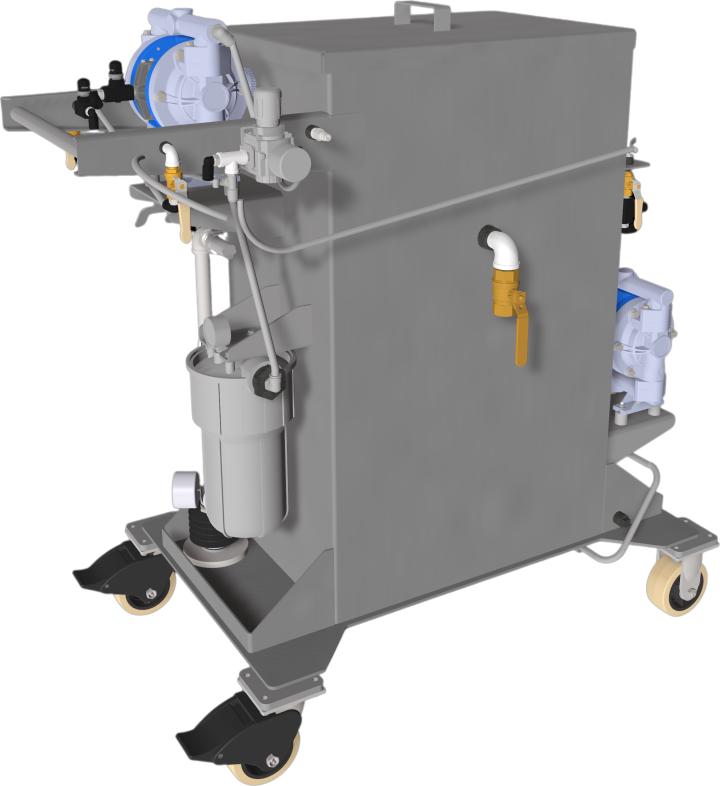


The PRAB MCR3 and MCR5 units are portable, mobile coolant recycling systems designed for machine shops, job shops, and metalworking facilities. Each unit rolls to the sump on heavy-duty locking casters, connects to standard shop air, and goes to work: removing tramp oil, separating floating contaminants, and returning clean, filtered coolant to the machine. No electricity. No dedicated plumbing. No installation.
These portable coolant filtration systems keep your coolant working as it should, reducing cutting tool wear and stretching coolant life, so you buy less and haul off less. Cleaner coolant also means better part finish and fewer surprise sump cleanouts. One or more cost-effective units can scale to your floor, require no dedicated operator, and are backed by PRAB’s Performantee guarantee.
The MCR3 (3 GPM) is suited for individual machines and lighter-duty applications. The MCR5 (5 GPM) is built for higher-volume sumps and multi-machine rotation. Both ship fully assembled and ready to use from day one.
When hydraulic oil, way lube, and machine oil migrate into your coolant sumps, the consequences are immediate and expensive: bacterial growth, foul odors, reduced tool life, degraded surface finish, and coolant that must be replaced rather than recycled. For a shop running 10 to 20 CNC sumps, unchecked tramp oil contamination can represent tens of thousands of dollars annually in unnecessary coolant purchases and hazardous waste disposal costs.
Coolant Degradation
Tramp oil reduces cooling and lubrication efficiency, increasing tool wear and lowering part quality.
Bacterial Growth
Tramp oil feeds bacteria in coolant sumps, causing odors, increasing dermatitis risk, and accelerating fluid breakdown.
Disposal Costs
Coolant that’s too contaminated to reuse gets hauled off and replaced, money spent on waste instead of production.
Compliance Exposure
POTW discharge limits and EPA regulations on fluid disposal are creating growing compliance obligations for metalworking operations.
Both mobile coolant recycler units process contaminated metalworking fluid through a two-stage separation sequence, driven entirely by compressed shop air.
01
Surface Skimming
The 6″ × 6″ accordion-style skimmer draws contaminated fluid from the sump surface. Its compact profile allows access to tight spaces that larger floating skimmer designs cannot reach. Additional sizes available.
02
Solids Filtration
Fluid passes through the integrated bag filter, which captures chips, fines, and suspended solids before the fluid reaches the coalescing chamber. An optional magnetic filter is available for ferrous-heavy applications.
03
Coalescence
Fluid flows through polypropylene tellerettes packed in a steel basket. The oleophilic, hydrophobic media causes oil droplets to merge and rise, reducing tramp oil in the coolant to below 1% by volume in a single pass.
04
Automatic Discharge
The vertical weir automatically separates the accumulated oil layer and discharges it into a customer-supplied waste container. Clean coolant returns to the sump continuously — no operator intervention required.
Not all portable coolant recyclers are built the same.
Automatic Tramp Oil Discharge
The vertical weir design continuously discharges separated oil into a waste container without operator intervention. No valves to open. No manual draining. No float adjustments.
Integrated Solids Filtration
Bag filtration is standard on every unit — not an add-on. An optional magnetic filter is available for environments with heavy ferrous particle loads. Many competing units offer neither.
Polypropylene Tellerette Media — Replaceable & Upgradeable
Individual polypropylene tellerettes are cleanable with the built-in air sparger and replaceable without removing the entire media pack. Upgrade to pall rings for applications requiring higher oil separation efficiency.
No Electricity Required
Both units run entirely on standard shop compressed air. No electrical circuit. No licensed electrician. No installation cost. Plug into your air line and start recycling.
Heavy-Gauge Carbon Steel Construction
Built from carbon steel — not plastic. Designed for the daily demands of a production environment: chemical exposure, physical contact, and the wear from constant shop-floor use.
Ships Fully Assembled. Ready Immediately.
Remove from the skid, connect shop air, position the skimmer, and start recycling. No assembly required. No tools. No time lost on setup that should have been done at the factory.
Every detail engineered for the people who actually use it.
Air-Powered Operation
Connects to standard shop compressed air. No electrical hookup is required at any point during installation, operation, or relocation.
3 or 5 GPM Flow Rate
Processes up to 3 (MCR3) or 5 (MCR5)gallons per minute — fast enough to turn around a contaminated sump in a single shift, then roll to the next machine.
Dedicated Tank Pump-Out
The 2nd pump is dedicated to emptying the unit so the MCR can be efficiently emptied for storage, relocation, or different fluids.
Built-In Air Sparger
An integrated air sparger agitates the fluid inside the coalescing chamber, accelerating oil separation and keeping the tellerette media clean between service intervals.
Gasketed Top Lid
A sealed, gasketed lid keeps the system contained during operation and eliminates spill risk when moving the unit between machines on a busy shop floor.
5″ Locking Rubber Casters
Heavy-duty locking casters roll smoothly across shop floors under full load and lock securely in place when the unit is positioned at a machine. Stable. Safe. Ready to work.
| Specification | MCR3 | MCR5 |
|---|---|---|
| Fluid Capacity | 13.5 gallons | 50 gallons |
| Flow Rate | Up to 3 GPM | Up to 5 GPM |
| Air Pump | AODD — air-operated diaphragm | AODD — air-operated diaphragm |
| Air Supply | Standard shop compressed air | Standard shop compressed air |
| Skimmer Type | Accordion-style, 6″ × 6″, Optional sizes available. | Accordion-style, 6″ × 6″, Optional sizes available. |
| Coalescing Media | Polypropylene tellerettes (pall ring upgrade available) | Polypropylene tellerettes (pall ring upgrade available) |
| Weir Design | Vertical — automatic continuous discharge | Vertical — automatic continuous discharge |
| Solids Filtration | Bag filter — standard | Bag filter — standard |
| Magnetic Filter | Optional add-on | Optional add-on |
| Air Sparger | Standard | Standard |
| Drain Pump | Secondary drain pump — standard | Secondary drain pump — standard |
| Lid | Gasketed top lid — sealed | Gasketed top lid — sealed |
| Mobility | 5″ heavy-duty locking rubber casters | 5″ heavy-duty locking rubber casters |
| Construction | Heavy-gauge carbon steel | Heavy-gauge carbon steel |
| Unit Weight (Empty) | 100 lbs | 360 lbs |
| Unit Weight (Full) | 260 lbs | 860 lbs |
| Electrical Required | None | None |
| Typical Payback Period | 6–9 months | 6–9 months |
The MCR3 and MCR5 portable coolant filtration systems are suited for water-soluble, semi-synthetic, and synthetic metalworking coolants across a wide range of manufacturing environments:
Already a Guardian Customer?
The MCR3 and MCR5 are the ideal companion units for satellite machines, standalone sumps, and any location your central Guardian Coolant Recycling System doesn’t reach. Part of the same Guardian family — portable, accessible, and ready to work.
What is a mobile coolant recycler?
A mobile coolant recycler is a portable unit that removes tramp oil and suspended solids from metalworking coolant sumps, restoring fluid performance and extending coolant life. Unlike centralized recycling systems, mobile units roll from machine to machine and require no permanent installation. The PRAB MCR3 and MCR5 use coalescing media and a bag filtration system to reduce tramp oil content in contaminated coolant to below 1% in a single pass.
How long does it take to clean a coolant sump with the MCR3 or MCR5?
At 5 GPM flow rate, most standard machine tool sumps can be turned around in a single shift. After cleaning one sump, the unit can be moved to the next machine and repositioned in minutes. A single MCR50 can typically service 10 or more sumps per week in a one-shift, five-day operation.
Does the MCR3 or MCR5 require electricity?
No. Both units operate entirely on standard shop compressed air via an air-operated double diaphragm (AODD) pump. No electrical circuit, licensed electrician, or installation cost is required.
What is the difference between the MCR3 and MCR5?
The MCR3 has a 13.5-gallon fluid capacity and is designed for individual machines and lighter-duty applications. The MCR5 has a 50-gallon fluid capacity and is suited for higher-volume sumps and operations where a single unit services multiple machines throughout the week. Both share the same flow rate, coalescing technology, and feature set.
What type of coalescing media does PRAB use?
PRAB MCR units use polypropylene tellerettes packed in a steel basket. Polypropylene is oleophilic — it attracts and coalesces oil droplets — and hydrophobic, allowing water-based coolant to pass through freely. Individual tellerettes are cleanable with the built-in air sparger and replaceable without removing the entire media pack. For applications requiring higher separation efficiency, polypropylene pall rings are available as an upgrade.
Can the MCR units handle coolant with metal chips or fines?
Yes. A bag filter is included as standard on both the MCR3 and MCR5 to capture chips, fines, and suspended solids before they reach the coalescing chamber. An optional magnetic filter is also available for environments with heavy ferrous particle loading.
How does a mobile coolant recycler compare to a centralized Guardian system?
The Guardian Coolant Recycling System is designed for centralized, high-volume fluid recycling across a full production line or facility. The MCR3 and MCR5 are portable companion units that deliver Guardian-class coolant recycling at the individual-machine level — ideal for shops that are too small for a full Guardian system or for facilities that need portable coverage for satellite machines and standalone sumps that the central Guardian doesn’t reach.

 (800) 968-7722
 (800) 493-3462