 Every plant manager and CFO has faced the same difficult calculation: the long-term savings from a modernized scrap and fluid management system are compelling on paper, but the capital exposure, installation complexity, and operational disruption feel anything but straightforward. The result? Facilities remain locked in a cycle of mounting haul-away costs, escalating coolant spend, and compliance risks that compound quietly year after year.
There is a better path— de-risking, and it does not require betting the plant on a single large project. For manufacturers willing to think in phases rather than projects, plant-wide scrap and fluid optimization becomes a series of low-risk, high-return investments that fund each successive stage. This roadmap shows you how.
When manufacturers consider a comprehensive metal scrap handling, coolant recycling, and wastewater treatment strategy, the same set of concerns tends to surface: high initial capital, installation downtime, maintenance commitments, floor space constraints, and the perceived risk of centralizing systems that touch every production line. These are legitimate concerns—and they are also the reason many facilities defer action while avoidable costs accumulate.
The financial case for acting in phases is more persuasive than waiting for a ‘perfect’ window. With 25% tariffs on imported steel and aluminum now embedded in input costs, coolant prices elevated, and scrap resale value increasingly tied to material purity and density, the margin impact of poor waste stream management is measurable and growing. According to PRAB’s documented customer results, facilities that implement phased chip-processing and coolant-recovery programs typically achieve full payback in 12 to 18 months.
“On average, [the scrap dealer] is giving me an additional 15% in value for dry chips instead of wet chips. That adds up to roughly $24,000 to $28,000 per year.” — PRAB Customer
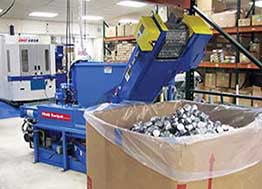
The most effective starting point for most facilities is also the least disruptive: metal chip processing at the production cell or department level. Most facilities are already generating metal chips and turnings. They are also already paying for haul-away, for coolant losses carried out with wet chips, and for depressed scrap resale prices due to contamination and low material density.
Implementing a briquetter, wringer, or shredding system at a single line or department requires no plant-wide changes. The economics are straightforward: PRAB’s documented results show that briquetted material commands up to 25 cents per pound more than loose chips, scrap volume can be reduced by up to 90%, and coolant reclaimed from chips is immediately reusable rather than hauled away as waste.
Before committing capital, PRAB’s FREE Materials Testing Program allows manufacturers to validate density improvement, coolant recovery rates, and projected resale gains using their own actual chips. This single step removes most of the financial uncertainty in Stage 1 and provides CFOs with defensible numbers for the capital request.
The Youngers and Sons Manufacturing case study clearly illustrates the impact. After implementing a PRAB Crusher/Wringer Chip Processing System and Guardian Coolant Recycling System, the company reduced haul-away costs by 18%, cut new coolant purchases by 38%, and increased scrap resale value by 12%—all in a phased deployment aligned with their facility expansion.
Read the full Youngers & Sons case study: prab.com/chip-and-fluid-waste-reductions
Stage 1 Typical Financial Outcomes
Once chip-level coolant recovery is operational, the logical next step is to extend coolant life across the facility. Coolant is one of the fastest-growing line items in metalworking operating budgets—and one of the most controllable. Tramp oil contamination, inadequate filtration, and reactive chemistry management drive up both the cost of new coolant purchases and the cost of coolant disposal.
PRAB’s Guardian Coolant Recycling Systems address this at the source. By filtering, conditioning, and recycling coolant centrally or by zone, facilities can reduce coolant disposal by 70–90% while improving fluid consistency, extending tool life, and reducing machine downtime caused by dirty fluid.
A common concern at this stage is whether centralized systems introduce single-point-of-failure risk. In practice, well-designed phased implementations use zone-based architecture, redundant pumps, and bypass controls to ensure machine-level operation continues during maintenance. Brownfield facilities can integrate Guardian systems during scheduled shutdowns or by department, avoiding large single-event disruption.
PRAB’s FREE Fluid Testing Program provides de-risking by validating filtration effectiveness, tramp oil removal, coolant chemistry stability, and potential for reduced disposal before any system is specified or purchased. It is the most direct way to quantify Stage 2 ROI before the capital conversation begins.
Explore the full Guardian Coolant Recycling System lineup: prab.com/fluid-filtration/guardian-coolant-recycling-systems
The aerospace manufacturing case study is particularly instructive for Stage 2 ROI. One facility achieved 50 gallons per hour of reclaimed cutting fluid through a combined briquetter and Guardian Coolant Recycling installation. Over a 2-shift, 5-day operation, that translates to approximately 600 gallons of recovered diluted coolant per day—fluid that would otherwise have been purchased new and disposed of as waste.
Case Study — Aerospace Manufacturer Turns Waste Stream into Revenue: prab.com/case-study-aerospace-components-manufacturer-turns-its-waste-stream

For many manufacturers, wastewater is where complexity seems to peak. Regulatory documentation requirements, chemistry management, footprint concerns, and operator training demands all contribute to wastewater being perpetually deferred—until a compliance event forces the issue at the worst possible time.
A phased approach to wastewater does not require a full Zero Liquid Discharge (ZLD) installation on day one. Most facilities can begin with targeted interventions: batch pH adjustment for specific discharge streams, oil-water separation for obvious contaminant loads, or ultrafiltration for defined process water streams. Each step improves compliance posture and reduces water and chemical costs while building toward more comprehensive treatment over time.
PRAB’s wastewater treatment portfolio—including ultrafiltration, vacuum evaporation, pH adjustment, UV disinfection, and full ZLD configurations—is documented at prab.com/water-and-industrial-wastewater-treatment-solutions. The same Free Fluid Testing Program used for Stage 2 applies here: actual wastewater samples are analyzed to validate treatment performance before installation.
CFO perspective: Stage 3 is fundamentally risk mitigation. EPA and state discharge violations carry fines, consent order costs, and reputational exposure that dwarf the capital cost of phased treatment systems. Framing this stage as regulatory insurance with an operational cost offset is the most accurate financial framing.
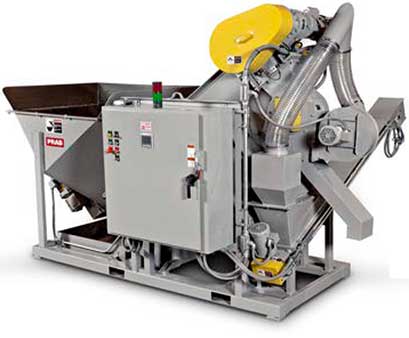
Most metalworking facilities are not blank slates. They operate legacy conveyors, mixed OEM equipment, varying coolant chemistries across production lines, and constrained floor plans that weren’t designed to accommodate modern fluid-management infrastructure. This is precisely the environment where PRAB’s 70-year history of brownfield integration delivers its most distinct competitive advantage.
PRAB systems are routinely engineered to interface with existing conveyors, replace aging components incrementally, integrate into current PLC and HMI architectures, and expand over time as original equipment phases out. The staged replacement strategy spreads capital expenditure across fiscal years, avoids large single-event disruption, and allows engineering teams to validate performance at each phase before authorizing the next.
This approach also addresses the floor space concern that surfaces in nearly every facility assessment. Volume reduction at Stage 1—compacting scrap by up to 91% through briquetting—typically frees meaningful floor space, offsetting the footprint of downstream coolant or wastewater equipment installed in later phases.
Learn more about PRAB’s brownfield integration capabilities and the PRAB Difference at prab.com/the-prab-difference
Facilities machining aluminum, magnesium, titanium, or other reactive metals face specific handling and coolant management requirements that generic systems do not address. Wet metal fines from reactive alloys can present fire and explosion risks when improperly stored or processed. PRAB’s application-specific engineering accounts for these material characteristics in conveyor selection, chip-processing configuration, and coolant-chemistry management—ensuring that safety is built into the system design rather than addressed reactively after installation.
The compounding logic of phased investment is straightforward:
Each stage stands independently. Each produces measurable, documentable ROI. And each reduces the operational friction and financial risk of the next. For CFOs managing capital allocation across competing priorities, this structure is far more defensible than a single large system investment.
Plant-wide scrap and fluid optimization does not have to mean a single large, disruptive capital commitment. For manufacturers willing to approach it in stages—starting where the data points and the ROI is fastest—it means converting waste streams into predictable financial assets while managing risk at every step.
The path is well-documented. The results are measurable. And the tools to validate before you invest are available at no cost.
At each stage, reduce cost, reduce waste, and strengthen the operational resilience that defines a high-performing manufacturing operation.
Paul Montgomery is the Marketing Manager at PRAB, Inc., a global manufacturer of engineered metal scrap handling, coolant recycling, and industrial wastewater treatment systems. With more than 30 years of experience across manufacturing, SaaS, custom development, healthcare, and education, he specializes in data-driven marketing that translates plant-floor performance into executive-level financial results. His work centers on total cost of ownership, automation integration, and closed-loop manufacturing strategies that help industrial companies reduce waste, conserve resources, and improve long-term profitability.
Free Testing Programs
Product & Solution Pages
Case Studies
White Papers & Knowledge Resources


 (800) 968-7722
 (800) 493-3462