
Wet chips, bushy turnings, stamping skeletons, hot-die-cast scrap, abrasive fines, and coolant-saturated slugs behave differently from bulk dry material. Conveyor selection in these environments determines uptime, maintenance burden, coolant retention, and long-term cost per ton handled.
PRAB is not simply a recycling equipment provider.
PRAB engineers and manufactures a complete range of industrial conveyors designed specifically for metalworking and special-use operations.
PRAB metal scrap conveyor systems support machining, stamping, die casting, forging, grinding, and fabrication facilities through a wide range of configurations:
Each design addresses a specific scrap type, duty cycle, and plant layout challenge.
This breadth matters — because metal scrap streams vary dramatically.
Metalworking environments create scrap that is:
A conveyor designed for dry warehouse use will fail prematurely under these conditions.
PRAB designs conveyors around scrap behavior — not catalog categories.
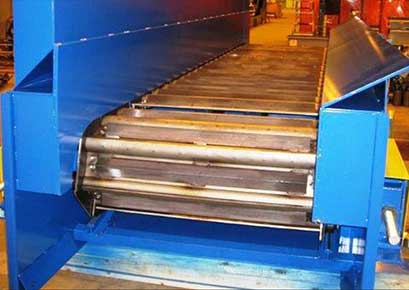
PRAB steel belt conveyors are engineered for heavy-duty metal scrap handling, including sharp stampings, bushy turnings, and high-impact loads. Built with reinforced frames and heavy-gauge steel belts, these conveyors are designed for severe-duty applications where durability, fluid retention, and long service life are critical. Ideal for machining, stamping, and die casting operations, steel belt conveyors provide reliable elevation and transfer in demanding production environments.
PRAB Pivot Belt conveyors are specifically designed to handle oily, sticky, and stringy metalworking scrap. The overlapping steel belt pans pivot as they travel, reducing carryback and minimizing jamming from wet chips and tangled swarf. This design improves coolant retention, reduces cleanup, and delivers dependable performance in high-volume machining applications.
Ideal for hot, wet, or abrasive scrap and parts transfer, oscillating conveyors use an eccentric single-drive design with minimal moving components. This reduces maintenance and improves reliability in harsh environments while supporting smooth, controlled material flow.
Designed specifically for stamping operations, ScrapVeyor II conveyors provide heavy-duty, leak-proof scrap movement while retaining cutting fluids. This reduces shop floor cleanup and extends coolant life in high-volume press applications.
Used for metered feeding and chip transfer, screw conveyors efficiently collect and move wet or dry scrap in CNC machining environments. They integrate seamlessly with shredders, crushers, or wringer systems.
For abrasive materials such as cast-iron turnings, PRAB drag conveyors feature abrasion-resistant flight bars and liquid-tight trough construction, delivering enclosed scrap handling with a long service life.
When floor space or layout complexity limits mechanical systems, pneumatic conveyors offer flexible routing for wet or dry chips, moving scrap overhead or around obstacles to centralized processing areas.
In die cast and forging environments, quench conveyors provide controlled cooling for hot parts and scrap, minimizing splatter and improving process consistency.
For ferrous scrap, magnetic conveyors eliminate carryback and exposed moving parts in the scrap stream, reducing maintenance while ensuring reliable incline transport.
For centralized scrap collection in machining and stamping facilities, in-floor trough conveyors offer low-profile, liquid-tight transport that supports plant automation and floor-space optimization.
PRAB load-out systems complete the scrap flow process—ensuring efficient trailer or railcar filling while maximizing payload and reducing hauling costs.
Choosing the correct metal scrap conveyor in a metalworking facility requires evaluating:
Incorrect selection leads to:
PRAB engineers conveyors around these variables to ensure stable, long-term performance.
Another key differentiator: PRAB conveyors are not standalone components.
They are engineered to integrate with:
This systems-level approach reduces fluid loss, improves scrap resale value, and supports plant-wide automation strategies.
PRAB designs metal scrap-handling systems as part of a comprehensive metal management infrastructure.
In high-production environments, conveyor downtime is costly.
PRAB conveyors are built with:
Many PRAB conveyor systems operate for decades in continuous-duty environments.
When evaluated over a 20- to 40-year lifecycle, durability significantly lowers the cost per ton handled compared to lower-priced alternatives that require frequent replacement.
For plant managers and CFOs, this shifts the conversation from purchase price to total cost of ownership.
Modern manufacturing requires integration with:
PRAB conveyors are designed for automation compatibility, supporting lights-out manufacturing and real-time monitoring where required.
This positions PRAB not just as a conveyor builder, but as an infrastructure partner for modern metalworking facilities.
From machine discharge to final load-out, scrap movement impacts productivity, safety, housekeeping, coolant retention, and long-term profitability.
PRAB engineers a comprehensive range of conveyor systems purpose-built for metalworking environments — addressing everything from fine ferrous chips to heavy stamping skeletons and hot die cast scrap.
When conveyor selection is treated as infrastructure rather than an accessory, reliability improves, maintenance decreases, and lifecycle costs decline.
PRAB is not just part of the metal scrap system; PRAB builds the backbone of it.
About the Author
Paul Montgomery is the Marketing Manager at PRAB, Inc., a global manufacturer of engineered metal scrap handling, coolant recycling, and industrial wastewater treatment systems. With more than 25 years of experience across manufacturing, SaaS, custom development, healthcare, and education, he specializes in data-driven marketing that translates plant-floor performance into executive-level financial results. His work centers on total cost of ownership, automation integration, and closed-loop manufacturing strategies that help industrial companies reduce waste, conserve resources, and improve long-term profitability.


 (800) 968-7722
 (800) 493-3462