Selecting the right metal scrap conveyor isn’t just about moving chips from A to B—it’s about reliability, throughput, coolant carry-over, maintenance load, and long-term total cost of ownership. With modern machining, stamping, and foundry operations running at higher speeds and volumes than ever, the wrong conveyor can become a hidden bottleneck. That’s why this Blog walks you through the five critical decision points for choosing a conveyor that genuinely fits your operation and delivers decades of service.
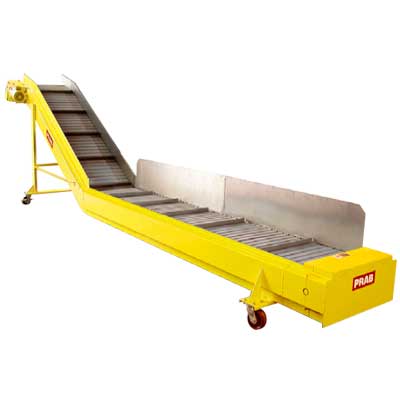 Know your Scrap: Geometry, Volume & Conditions
The first step is understanding the metal scrap you’re handling. Are you dealing with fine-machining chips, heavy stamping turnings, hot-die-cast parts, or mixed-metal scrap with coolant? The geometry matters because curved, bushy, or chain-like turnings behave differently on conveyors than straight shavings do. Volume matters because high tonnage may require surge capacity and faster belt speeds. And conditions matter—wet, oily, or hot scrap places place different demands on engineering materials and belt selection.
If your scrap is wet or your process involves coolant-laden chips, carry-over becomes a major issue. Selecting a conveyor that handles scrap and fluid together (rather than one that dumps fluid off and then conveys dry chips) can reduce downstream headache. For example, an under-press steel belt can trap coolants and allow separation, while other conveyor types may enable coolants to pool or overflow. For guidance: see the FAQ on “What types of metal scrap conveyors are used in metalworking industries?”.
Not all conveyors are created equal. Here’s a high-level comparison:
PRAB Conveyor Type: |
Best Conveyor Usage: |
Steel Belt Conveyors |
For the most versatile general-purpose handling of metal scrap — both wet or dry, including bushy turnings, die scrap, chips, and parts. |
Pivot Belt Conveyors |
Specifically for thin-gauge or oily scrap where carry-over is an issue — e.g., stamping slugs, stringy trim, oil-soaked pieces. |
Oscillating (Vibratory) Metal Scrap Conveyors |
For moving heavy, hot, wet, or abrasive scrap or finished parts horizontally (or slightly inclined) with minimal belt failures — especially in harsh environments. |
ScrapVeyor II Conveyors |
Designed for stamping scrap applications: elevating/discharging slugs, chips & trim while keeping fluids contained (leak-proof), improving cleanliness and operation around presses. |
Screw Conveyors |
For efficient handling of abrasive, dense metal chips/fines — particularly where space constraints exist or where enclosed transport is needed. |
Drag Conveyors |
Built for the most severe duty: large volume, highly abrasive scrap (bushy turnings, dry cast iron chips) with low maintenance in rugged environments. |
Pneumatic Conveyors |
Best when scrap/chips need to be moved long distances, overhead, between cells, or across the plant, especially lightweight materials or where floor space is premium. |
Quench Conveyors |
When parts or scrap require cooling in water (or liquid quench) because air cooling is inadequate, e.g., die-cast or forging off-cuts. |
Casting Coolers |
For air-cooling hot die-cast parts or scrap where water quench would cause misting/air-quality issues — often in foundry or die-casting environments. |
Furnace Feeders |
For meter-feeding abrasive die-cast scrap or melting feed directly into a furnace — protects operators, integrates into remelt systems. |
Magnetic Conveyors |
When handling ferrous chips, turnings, stamping slugs/parts, ensure positive discharge without carry-over of ferrous material, often wet or dry. |
In-Floor Trough Conveyors |
For high-volume scrap/chip removal integrated into the floor (in-floor installation) — minimal footprint, handles wet or dry applications, suitable for machine/press cells where floor-level scrap removal is needed. |
Load-Out Systems |
For the final transfer of scrap into containers/trailers/railcars: maximizes container fill, automates load-out, best for high-volume recycling or scrap transport logistics. |
Selection comes down to matching the scrap profile, fluid presence, incline, and space constraints. Speak with a PRAB Conveyor Expert
Your layout has a significant impact. How far must the scrap travel? Is the conveyor inclined or horizontal? Are there in-floor troughs feeding multiple presses? Will you surge scrap ahead of a shredder or directly to a load-out hopper? These questions determine conveyor width, belt pitch, speed, surge volume, incline angle, and drive sizing. For instance, a high-volume stamping line may need a wide belt steel conveyor with integrated surge and automatic load-out. (See PRAB’s Load-Out Systems:
One of the most significant hidden costs in scrap handling is equipment replacement or failure during a production shutdown. PRAB conveyors are engineered for 30+ years of service in harsh environments. (For example: the “48 Years” case study.)
When you choose a conveyor, look for: strong construction, easily accessible service points, and a supplier with a proven track record of servicing older systems.
Conclusion
Choosing the right metal scrap conveyor means considering scrap type, coolant, conveyor technology, layout constraints, and future service life. For a reliable, well-engineered solution designed for decades, not just years, talk to an expert at PRAB.


 (800) 968-7722
 (800) 493-3462