Walk through any production machining facility, stamping plant, or die-casting shop, and you will find one constant: metal scrap. The chips, turnings, stampings, and flash that accumulate on and around machine tools represent both a housekeeping challenge and a real cost center. Scrap conveyors are the circulatory system of efficient chip management — they move material away from the point of generation, protect people and equipment, and feed downstream processing steps that recover commodity value and reclaim cutting fluid. Selecting the wrong conveyor type, however, can reduce throughput, create maintenance headaches, and leave money on the shop floor. This guide breaks down the primary categories of industrial scrap conveyor systems, explains the application variables that drive selection, and outlines the performance questions you should ask before specifying equipment.
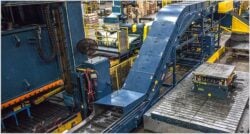
Metal scrap is not a monolith. The chip type, metal alloy, temperature, wetness, and production volume you are dealing with all vary — sometimes dramatically — across machine tool types and manufacturing processes. A light aluminum chip produced on a CNC turning center behaves very differently from a heavy cast-iron slug leaving a foundry shakeout line, and both differ again from the hot, scale-covered scrap exiting a forging press.
Choosing a conveyor that cannot handle your specific material profile results in jams, accelerated wear, excessive downtime, and potential injury. Conversely, over-specifying a conveyor — installing a heavy-duty sealed drag chain unit when a simple hinged steel belt would suffice — wastes capital and increases routine maintenance costs.
Hinged steel belt conveyors are the workhorse of CNC machining chip removal. The interlocking steel plates form a continuous flat surface that carries wet chips, coolant, and fine particulate away from the cutting zone. They are well-suited for ferrous and non-ferrous metal chips in moderate volumes and can handle oil-laden material without leaking because the through-coolant drains back into the sump.
For metalworking applications involving standard machining centers, the hinged steel belt is often the default specification. PRAB’s steel belt conveyor lineup, including its patented Pivot Belt conveyor, is engineered for minimal maintenance intervals and a long service life in wet-chip environments.
Drag conveyors use a submerged chain with flights to push or pull heavy, abrasive, or bulky scrap through a trough. They excel in foundry and casting environments where flash, risers, and irregular scrap pieces would jam or prematurely wear a belt-style unit. Ferrous scrap conveyors in foundry settings almost always require a drag configuration because the material is too rough and too heavy for alternative designs.
Drag conveyors are also the preferred solution for embedded scrap conveyors — units built into the floor of a machining cell — because the enclosed trough keeps chips contained and coolant from splashing into the work area.
Magnetic conveyor systems use permanent magnets beneath the conveyor surface to carry ferrous chips and fine turnings without mechanical clamping. This contactless approach eliminates many of the pinch points and jam risks associated with conventional chip conveyors, making magnetic chip conveyors a strong fit for fine ferrous swarf generated in grinding, honing, or light turning operations.
Because the chips travel clinging to the underside of the belt in many designs, magnetic conveyors also allow coolant to drain freely, reducing the moisture content of the chip stream before it reaches a wringer or briquetter.
The screw conveyor for metal chips — sometimes called an auger conveyor — uses a rotating helical screw inside a tube or trough to push chips from one point to another. Screw conveyors are particularly useful for moving material up inclines, around corners, or through tight spaces where a standard belt conveyor cannot fit. They handle wet or dry chips equally well and are a common component in automated cell designs where the conveyor must snake through a cluster of machine tools.
Their limitation is throughput: at high chip volumes or with tangled, stringy turnings, screw conveyors can bind. Proper sizing and chip processing upstream—such as shredding or crushing long turnings—resolve this issue.
Quench and Water-Tight Conveyors
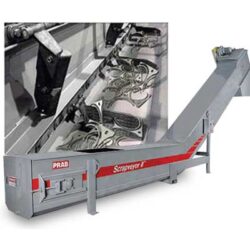 Water quench conveyors are designed to receive hot scrap from forging presses, die-casting machines, and heat-treat furnaces, and rapidly cool the material before it reaches downstream equipment or shipping containers. The unique Scrapveyor conveyor features a trough containing a water bath, with scrap submerged or sprayed as it moves through the system.
Cooling conveyors for hot scrap applications require fully water-tight construction — welded seams, sealed bearings, and corrosion-resistant materials — to survive continuous submersion and thermal cycling. PRAB’s quench conveyors are built to meet these demands in high-heat, high-abrasion environments.
Oscillating and Vibrating Conveyors
Oscillating conveyors use a back-and-forth motion to move scrap along a trough. Because they have no belt, chain, or flights in contact with the material, wear rates are dramatically lower than mechanical alternatives — a significant advantage in heat-resistant scrap conveyor applications where the material is hot, abrasive, or both.
Oscillating conveyors are common in foundry shakeout lines and forging operations, and they pair well with vibratory feed equipment.
Before specifying any conveyor system, your equipment supplier needs to understand:
Stamping conveyors handle thin-gauge sheet scrap, skeletons, and blanks that a chip conveyor was not designed to carry. The material is flat, often tangled, and can bridge across standard conveyor troughs. Stamping scrap systems use wider belts, special flights, or vibrating designs to keep material moving and prevent nesting.
Forging and die casting applications introduce extreme temperatures, scale, and heavy chunk scrap. PRAB’s application engineering team has developed specific designs for these environments — see the forging and casting conveyor selector guide for details on material handling, cooling, and speed requirements.
The most efficient metal scrap-handling systems treat the conveyor not as a standalone piece of equipment but as the first stage of an integrated chip-and-fluid management system. Chips leaving the machine tool still carry 10–25% cutting fluid by weight. By the time scrap reaches a dumpster, that coolant is lost.
Integrating conveyors with wringers, centrifuges, briquetters, and coolant recycling systems captures that fluid for re-use and increases the commodity value of the processed chip. PRAB engineers regularly design integrated systems that include multiple conveyor types feeding a central processing station, maximizing material recovery and minimizing the labor required to move material from point to point.
The right scrap conveyor system is the one that reliably handles your specific material, fits your facility layout, integrates with your process, and is economical to maintain over a 10–15-year service life. There is rarely a universal answer — the same plant may need a hinged steel belt for the CNC cell, a drag conveyor for the foundry line, and a magnetic unit for the grinding department.
PRAB’s engineering team can perform a no-obligation system review and recommend a conveyor configuration based on your chip types, volumes, and downstream goals. Contact us at 1-800-968-7722 or Sales@PRAB.com to get started.
→ Explore PRAB Conveyor Systems
About the Author
Paul Montgomery is the Marketing Manager at PRAB, Inc., a global manufacturer of engineered metal scrap handling, coolant recycling, and industrial wastewater treatment systems. With more than 30 years of experience across manufacturing, SaaS, custom development, healthcare, and education, he specializes in data-driven marketing that translates plant-floor performance into executive-level financial results. His work centers on total cost of ownership, automation integration, and closed-loop manufacturing strategies that help industrial companies reduce waste, conserve resources, and improve long-term profitability.


 (800) 968-7722
 (800) 493-3462