In high-precision metalworking, coolant condition directly affects productivity and part quality. As tramp oils, fine metal particulates, and bacteria accumulate, coolant loses lubricity and thermal control, causing premature tool wear, poor surface finishes, and part rework. This is where Coolant Recycling Systems become essential.
Many plants still manage coolant individually at each machine’s sump, relying on manual dosing or pump-out services. This decentralized approach increases labor, chemical use, and downtime.
A centralized coolant recycling system, like the PRAB Guardian™, transforms this process into a closed-loop operation, continuously filtering, purifying, and re-supplying clean coolant to every machine in the network.
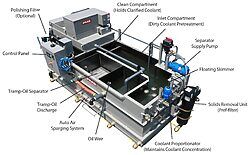 How a Centralized Coolant Recycling System Works
A PRAB Guardian™ system connects multiple CNC and machining centers through return and supply lines. Dirty coolant from each sump is transferred to a collection tank, then processed through separation and filtration stages before being pumped back clean.
A typical setup includes:
This configuration eliminates the need to manually mix, haul, or dispose of coolant, making it a cornerstone of smart-factory fluid management.
Contaminated coolant accelerates tool wear and spindle degradation. Clean, balanced coolant maintains optimal viscosity and temperature, extending tool life by up to 25 % and improving machine reliability.
Manual sump clean-outs can halt production for hours. Automated recycling keeps coolant within specification continuously, allowing maintenance to focus on planned service rather than emergency cleanups.
Centralized processing ensures every CNC station receives coolant with identical concentration, pH, and cleanliness, critical for aerospace, automotive, and medical-device tolerances.
By recycling up to 98 % of spent coolant, PRAB systems drastically reduce waste disposal volumes and chemical purchases, supporting ISO 14001 and EPA waste-minimization initiatives.
Centralized coolant recycling often works alongside complementary PRAB technologies for maximum efficiency:
| System | Function | Benefit |
| Tramp Oil Separator | Removes oil contamination | Extends coolant life, reduces odor |
| Guardian™ Coolant Recycling System | Centralized fluid purification | 98 % recovery efficiency |
| Paper Bed Filter | Fine-particulate filtration | Protects pumps and tooling |
| Centrifuge Fluid Recycling System | Removes ultrafine particles | Improves coolant clarity |
| Automated pH Control System | Balances water chemistry | Enables closed-loop reuse |
Together, these systems create an integrated metalworking fluid-recycling ecosystem that optimizes uptime, safety, and environmental performance.
Plants implementing a PRAB Guardian™ system routinely achieve payback in 6 to 18 months, with savings in:
Environmental teams also report reductions in volatile emissions and improved facility air quality.
A Tier-1 automotive supplier operating 28 CNC machines installed a PRAB Guardian™ with integrated tramp-oil separation and paper-bed filtration. Results after six months:
This installation also simplified compliance reporting by providing digital logs of coolant usage and discharge data.
Centralized systems require less manual oversight and offer predictive-maintenance data on pump flow, pressure, and contamination levels. These insights enable condition-based service instead of reactive maintenance, reducing unscheduled downtime and component failures.
By reusing coolant rather than disposing of it, plants align with sustainable manufacturing standards such as ISO 14001 Environmental Management Systems and demonstrate measurable reductions in waste generation for corporate ESG reporting.
Explore the PRAB Guardian™ Coolant Recycling System to see how it can improve uptime and reduce costs in your operation.
FAQ
Q1: What is a centralized coolant recycling system?
It’s an integrated loop that collects used coolant from multiple machines, filters and purifies it, then returns it clean, eliminating manual sump maintenance.
Q2: How much coolant can be recovered?
PRAB Guardian™ systems typically recover 95 – 98% of coolant for reuse, reducing waste and purchase costs.
Q3: What’s the typical ROI?
Most facilities achieve ROI within 6 – 18 months, depending on production volume, fluid type, and disposal expenses.


 (800) 968-7722
 (800) 493-3462