 Every manufacturing process that uses water, whether for cooling, cleaning, plating, or machining, creates wastewater with fluctuating pH. Those fluctuations can result from spent coolant, tramp oils, cleaners, or metal-bearing fluids. When pH drifts outside the EPA- or POTW-required 6.0–9.0 range, facilities risk heavy surcharges, permit violations, or even forced shutdowns. That’s where pH Control Systems are important.
Manual monitoring often introduces inconsistent dosing, operator exposure to chemicals, and wasted reagents. For plant and environmental managers seeking reliable compliance and lower treatment costs, automated pH control systems deliver the precision and repeatability that manual methods can’t.
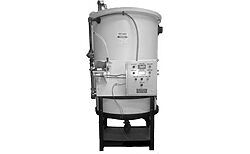
A PRAB Automated pH Control System continuously monitors influent and effluent water streams using industrial-grade sensors and controllers. When readings deviate from the setpoint, the system automatically doses the appropriate acid or caustic solution to neutralize the stream, without human intervention.
A typical configuration includes:
These systems can operate as stand-alone units or integrate directly into a broader PRAB Process Water or Industrial Wastewater Treatment Solution.
 Precise, Repeatable Control
Automated feedback loops maintain target pH within narrow tolerances. This precision reduces chemical waste, prevents system upsets, and reduces downstream filtration loading.
Once programmed, the controller manages dosing 24/7, eliminating the need for manual testing every shift. Operators can reallocate time toward preventive maintenance or production support.
Stable pH values help prevent fines and ensure compliance with Publicly Owned Treatment Works (POTW) and EPA requirements. Data logging provides auditable records for environmental reporting.
Automated dosing reduces direct handling of caustics and acids, improving safety for maintenance and EHS staff.
PRAB’s automated pH control systems are designed for seamless integration into complete wastewater treatment lines. Typical configurations include:
| Integrated Equipment | Function | Benefit |
| Ultrafiltration Systems | Removes emulsified oils & fine solids | Protects membranes and reuses loops |
| Evaporators | Concentrates and reduces waste volume | Lowers disposal costs |
| Clarifiers & Filtration Modules | Separates solids from liquids | Improves clarity before discharge |
| Guardian™ Coolant Recycling System | Recycles machining coolant | Complements pH balancing for total fluid management |
This modular approach enables engineers to create closed-loop systems that reuse up to 90% of process water, supporting ISO 14001 and corporate sustainability goals.
Facilities that implement automated pH control often realize payback in 12–24 months through:
Environmental managers also cite measurable reductions in corrosion, scaling, and sludge production, improving reliability across pumps, piping, and filters.
A Midwestern automotive components facility partnered with PRAB to automate its pH neutralization process. The result:
The project integrated with the plant’s Guardian™ Coolant Recycling System, allowing treated water to be reused for floor cleaning and secondary machining operations.
Automated systems help satisfy evolving compliance frameworks, such as:
With remote monitoring and digital data logs, EHS managers can access historical pH trends for audits and sustainability reporting without manual spreadsheets.
Key Takeaways
For more information, visit PRAB’s Process Water Treatment Solutions.
FAQ
Q1: How does automated pH control work?
Automated pH control uses sensors to measure water acidity and alkalinity in real time. A controller doses acid or base automatically until the target range is achieved, ensuring consistent discharge compliance.
Q2: What industries benefit most from automated pH control?
Metalworking, die casting, plating, food processing, and general manufacturing operations that generate variable-pH wastewater benefit from automation to reduce operator workload and improve compliance.
Q3: What is the ROI for PRAB’s automated pH systems?
Most facilities achieve ROI within 12–24 months through chemical savings, reduced surcharges, and improved water reuse efficiency.


 (800) 968-7722
 (800) 493-3462