A magnetic slide conveyor moves ferrous chips, turnings, stamping slugs, and small parts using permanent magnets mounted on a chain that runs beneath a stationary stainless steel slider bed. The magnets grip the material through the slider surface and carry it to the release point, where the chain curves away, dropping the material cleanly with no carryover. Because the slider bed never moves, there is no belt to wear, jam, or contaminate. That is why a beltless magnetic conveyor is often the right choice for wet, oily, fine ferrous scrap in CNC machining, stamping, and grinding, where conventional belt conveyors struggle.
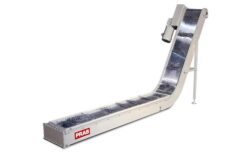 How a Beltless Magnetic Slide Conveyor Works
The mechanism is simple and proven, which is part of why these systems last for decades in harsh production environments:
The magnetic field holds material firmly against the slider surface even on inclines. That makes a magnetic conveyor well suited to elevation changes that would cause fine chips or light stampings to spill off an open belt.
 Magnetic Slide Conveyor vs. Magnetic Separator: A Distinction Worth Understanding
The term “magnetic conveyor” gets applied to two different machines, and buyers often compare equipment that does not do the same job. Knowing the difference prevents specifying the wrong tool.
A magnetic slide conveyor is a transport device. Its job is to move ferrous chips and small parts from the point of generation to downstream equipment or a container, cleanly and without carryover, including up inclines and around layout changes.
A magnetic separator, or a magnetic filtration conveyor, is a separation device. Its job is to remove fine ferrous particles from a coolant stream, keeping the fluid cleaner. That is a filtration function, not a material transport function.
Both have a place in a metalworking plant, and they are sometimes used together. The point is to match the machine to the outcome you need. If the goal is to reliably move thin or fine ferrous scrap to a wringer, briquetter, or bin, a magnetic slide conveyor is the transport solution.
A magnetic slide conveyor earns its place when the scrap is ferrous and prone to spilling, sliding, or sticking on a conventional belt. Use the quick comparison below to frame the decision, then confirm with material testing on your actual scrap.
| Selection factor | Magnetic slide conveyor | Hinged steel belt conveyor |
|---|---|---|
|
■ Material |
■ Ferrous only (steel, iron, ferrous alloys) | ■ Mixed ferrous and non-ferrous, or non-ferrous |
| ■ Chip form | ■ Fine chips, grinding fines, thin stampings, small parts | ■ Heavy, bushy, or high-volume turnings and die scrap |
| ■ Carryover | ■ Zero carryover, clean positive release | ■ Low, suited to bulk transport |
| ■ Design | ■ Beltless, no external moving parts | ■ Hinged steel belt, heavy-duty |
For mixed-metal scrap, heavy turnings, or non-ferrous material such as aluminum, titanium, or brass, a hinged steel belt or oscillating conveyor is the better fit. There is rarely a single universal answer. A plant may use a magnetic slide unit in the grinding department, a steel belt in the CNC cell, and a drag conveyor on the foundry line.
Many magnetic conveyors on the market are built for light parts handling or assembly. Metalworking is a harsher environment: wet, oily, abrasive, and continuous. The construction details that matter for high-volume ferrous scrap include:
The most effective scrap handling treats the conveyor as the first stage of a recovery process, not as a standalone machine. Ferrous chips leaving a machine tool carry a meaningful volume of cutting fluid by weight. Once that scrap reaches a bin, the fluid is lost, reducing the chip’s value.
A magnetic slide conveyor sets up the recovery step well. As it moves ferrous chips, coolant drains back rather than riding along, so the chip stream arrives drier at the next stage. Feeding that stream into wringers, centrifuges, or briquetters recovers cutting fluid for reuse and increases the commodity value of the processed chip. Pairing it with coolant recycling and, where needed, industrial wastewater treatment closes the loop on both the metal and the fluid.
This is where the conveyor decision connects to the larger financial picture. The question is not only how to move chips, but how much fluid and scrap value the operation can recover on the way.
Most magnetic slide conveyors look similar on a spec sheet. The meaningful differences show up in how a supplier removes risk from the buying decision and how long the equipment runs once installed.
Ferrous materials only, including steel and iron chips, grinding swarf, stamping slugs, punch-outs, turnings, and small ferrous parts. For mixed-metal or non-ferrous scrap, a steel belt or oscillating conveyor is the right choice.
Yes. The beltless slide design is built for wet, oily, contaminated scrap. It avoids the belt slippage and contamination problems that reduce belt conveyor performance in coolant-heavy environments, and it lets coolant drain back rather than carry along.
A magnetic conveyor grips ferrous material with magnetic force, making it well-suited for fine chips, light stampings, and any application where zero carryover matters. A steel belt conveyor uses a hinged belt and suits heavier, mixed-material, or non-ferrous scrap and long runs.
The most common failure points in chip conveyors are belt wear, belt jamming, and contamination of the belt by oily chips. A beltless slide conveyor eliminates that failure mode entirely, which is the core reason for its reputation for low maintenance.
The right magnetic conveyor is the one matched to your specific ferrous scrap, your layout, and your downstream recovery goals. PRAB’s engineering team can review your application, test your material, and recommend a configuration with documented performance. Call 1-800-968-7722 or click here to start.
About the Author
Paul Montgomery is the Marketing Manager at PRAB, Inc., a global manufacturer of engineered metal scrap handling, coolant recycling, and industrial wastewater treatment systems. With more than 30 years of experience across manufacturing, SaaS, custom development, healthcare, and education, he specializes in data-driven marketing that translates plant-floor performance into executive-level financial results. His work centers on total cost of ownership, automation integration, and closed-loop manufacturing strategies that help industrial companies reduce waste, conserve resources, and improve long-term profitability.


 (800) 968-7722
 (800) 493-3462