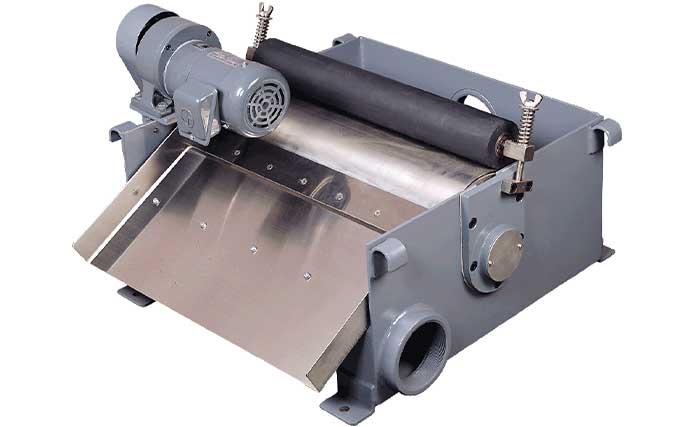


PRAB magnetic separators continuously remove ferrous chips, sludge, and fines from water-based coolants and straight oils. Using high-intensity rotating drum magnets, these systems capture contaminants before they reach downstream filtration equipment—extending coolant life and protecting machining processes.
Magnetic separators are commonly used in grinding, honing, gear cutting, and other operations where fine ferrous particles are suspended in coolant. As pre-filters or standalone solutions, they help maintain fluid clarity and consistent machining performance.

PRAB magnetic separators use a rotating drum fitted with high-intensity ferrite or rare-earth magnets. As contaminated fluid flows across the drum, ferrous particles are captured magnetically and carried out of the fluid stream. The cleaned fluid then continues to downstream filtration or back to the process.
This approach provides continuous separation without filter media, reducing maintenance while maintaining consistent coolant quality.

Rare earth models are used when there are large amounts of ferrous fines (smaller than 40 micron), large amounts of sludge accumulation in a machine’s coolant tank, or when the coolant has a high viscosity rating such as straight oil.
Magnetic separators employ high-intensity ferrite or rare earth magnets within a fully energized rotating drum to continuously remove ferrous particles from the flow of liquid. This scrap metal equipment is often used as a pre-filter to limit contaminants reaching subsequent filtration equipment and are well suited to processes where ferrous and non-ferrous contaminants are mixed with water-based coolants or straight cutting oils. PRAB offers 4 models depending on your application needs.
| Magnets | Ferrite | Rare Earth | ||
|---|---|---|---|---|
| Micron Rating | 40 | 15 | ||
| Gauss Rating | 1200 | 1600 | 3600 | 4200 |
| Flow Rate (GPM) | Model Number | Model Number | ||
| 5 | MCA-20 | – | – | – |
| 10 | MCA-40 | – | – | MSK-40 |
| 15 | MCA-60 | – | – | MSK-60 |
| 20 | – | MCJ-80A | – | MSK-80 |
| 25-30 | – | MCJ-120A | – | MSK-100 |
| 40-45 | – | MCJ-160A | – | MSK-150 MSK-180 |
| 60 | – | MCJ-240A | – | MSK-240 |
| 80 | – | – | – | MSK-300 |
| 95 | MCA-360 | – | SS-360 | – |
| 130 | MCA-500 | – | SS-500 | – |
| 210 | MCA-800 | – | SS-800 | – |
| 265 | MCA-1000 | – | SS-1000 | – |
| 315 | MCA-1200 | – | SS-1200 | – |
Product Brochures
Product Brochure: Magnetic Separator Product Family
Product Brochure: Magnetic Separators MCA
Product Brochure: Magnetic Separators Model MCJ-A
Product Brochure: Magnetic Separators Model MSK
Product Brochure: Magnetic Separators Model SS
Case Studies
Case Study: Ford Utilizes TW’s To Reduce High Tramp Oil Levels
White Paper
White Paper: Getting the Most Value from Metal Scrap and Spent Fluids
White Paper: Green Engineering
Other Downloadable Content
PRAB Fluid Filtration Solutions Product Selection Chart Brochure
PRAB Fluid Filtration Systems and Wastewater Treatment Brochure
PRAB Filtration Spectrum Brochure
PRAB Builds Equipment for the Toughest Jobs in Manufacturing and Metalworking
PRAB conducts comprehensive sample testing to develop a clear understanding of the unique characteristics of your mixed solution and its industrial applications. This test determines the optimal centrifuge system design and capacity to optimize filtration in your facility.

Or, contact us today at (800) 968-7722.
CHALLENGE Automaker suffers with production downtime and reduction in productivity due to excessive build-up over time of tramp oil from machining centers. CUSTOMER Ford Motor Company INDUSTRY Automotive PRODUCT Tramp Oil Separator, Magnetic Separators, Mobile Separator Business Benefits Realized Longer tool life of CNC machine Reduced maintenance requirements Consistant tramp oil levels which increase production When the “Big Three” automakers […]
When market factors reduce profit margins, metalworking operations should consider shifting their capital expenditures to back-end process systems.By Mike Hook, Sales & Marketing Director, PRAB Introduction In 2010, Modern Machine Shop magazine released its inaugural “Top Shops” benchmarking survey. Intended as an annual method for metalworking shops to compare their key performance indicators […]
Metalworking operations are often faced with unavoidable costs that are beyond their control. Two of the largest this year have been tariffs, and the cost of cutting fluids. Fortunately, there are many back-end solutions to help offset these costs that will add more value to metal scrap and spend fluids, and move profit margins in a positive direction. Machine […]

 (800) 968-7722
 (800) 493-3462