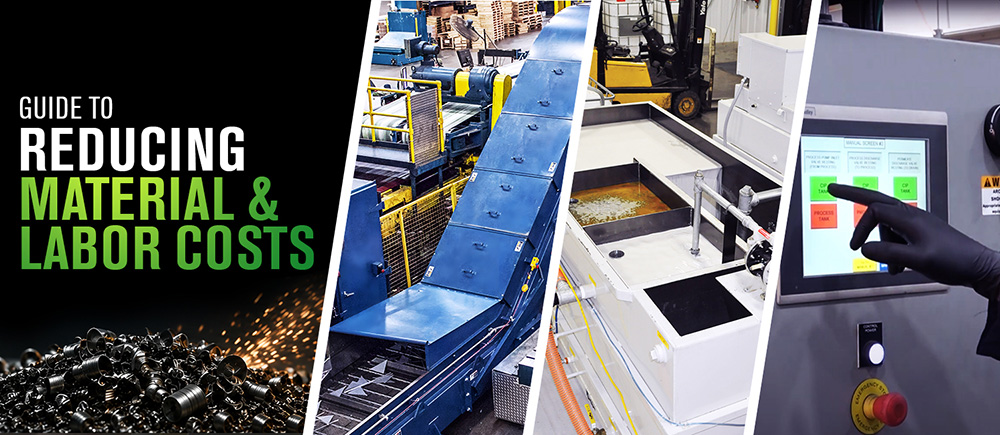
For metalworking shops, production efficiency is the name of the game for elevating the bottom line. But equally as important as overall productivity is resource management, minimizing waste and maintaining compliance.
In this guide, we’ll look at how metalworking operations can take a strategic approach to reducing material and labor costs through these key areas:
In today’s metalworking shops, automation has become essential for improving efficiency, safety and lowering operating costs. When integrated directly into scrap handling, fluid recycling and wastewater systems, automation delivers measurable improvements across the entire plant.
That is why industrial automation is no longer a nice-to-have.
It is integral for the entire process, from fluid management to scrap handling and waste discharge. When you combine heavy-duty equipment with advanced, intuitive control systems, operations realize higher uptime, reduced costs and better production.
Instead of complete reliance on manual adjustments and maintenance, automation employs programmable logic controllers (PLCs), human-machine interfaces (HMIs) and advanced sensors to maintain optimal conditions and allow for rapid response to errors.
These factors are particularly important in an environment where variables like scrap load, fluid chemistry and waste can change by the minute.
Immediate Process Improvements That Automated Systems Deliver
Ultimately, using automated systems improves both the immediate process and operational longevity, protecting equipment and extending its useful life.
____________________________________
II. Finding the Right Metal Scrap Conveyor
Efficient material handling is crucial for the success of metalworking shops.
Without the ability to move material consistently, scrap will accumulate, increasing safety risks, labor costs and unplanned downtime.
This makes conveyors the workhorses of the facility, but they are not a one-size-fits-all system. Finding the right conveyor means matching the equipment to the exact scrap volume, coolant conditions, facility layout and power requirements.
If your facility handles heavy materials like metal chips, turnings or stamping offcuts, the right conveyor can significantly improve safety and process efficiency, helping operations achieve fast ROI and improving bottom-line revenue.
Which type of conveyor best meets your needs? Here are some critical considerations for finding a custom-engineered conveying system to improve your process and reduce costs.

Steel Belt Conveyors
Steel belt conveyors are strong and versatile, built with heavy-duty hinged belts and abrasion-resistant components. They can efficiently handle many types of common metal scrap.
Ideal for: Wet and dry scrap, mixed materials, heavy and abrasive turnings.

Pivot Belt Conveyors
Pivot belts are designed to solve for carryover, a common problem in metalworking shops. They are constructed with a unique hinged design, rigid surfaces and a sturdy, reinforced framework that allow for easy handling of sticky, challenging waste like oily slugs or stamping trim.
Ideal for: Thin-gauge, oily or stringy scrap.

Oscillating (Vibratory) Conveyors
For simple, effective chip movement, oscillating conveyors deliver the goods. These systems use vibration to move scrap along troughs. With fewer moving parts than belt systems, these conveyors move chips directly at the machine interface or across short distances. Their quiet operation and minimal complexity make them an excellent choice for straightforward chip hauling.
Ideal for: Hot, wet or abrasive chips or horizontal transport.

Magnetic Conveyors
These continuous-duty, beltless slide conveyors use permanent ceramic magnets beneath a stainless steel slider bed to move a wide range of wet or dry material and finished parts without carryover or any external moving parts.
Ideal for: Wet or dry ferrous chips, stamping slugs, grinding fines and finished parts.

Drag Conveyors
Drag conveyors are rugged machines built with durable drag chains with steel flights that pull heavy material through abrasion-resistant troughs. These conveyors are built to move large loads of heavy metal chips, die-casting trim or stamping scrap over longer distances or in submerged in-floor configurations.
Ideal for: Heavy scrap, fines and abrasive materials.
Specialty Material Handling Systems
Unique plant conditions may require specialized conveyors:
Your conveyors should always be built for your facility’s unique needs, including space, coolant recovery, and throughput requirements. This will help keep material moving, improve production, reduce labor costs and accelerate ROI.
____________________________________
III. Improve Your Waste Stream Processing for Cost Savings and Compliance
In metalworking operations, industrial wastewater and spent cutting fluids are two critical aspects of waste stream management that can help reduce expenses and maintain environmental compliance.
As compliance penalties continue to rise, companies can minimize their financial risks and lower operating costs with more effective waste stream management.
Mitigating potential liabilities often involves using several processes in combination to achieve zero liquid discharge goals, primarily: ultrafiltration and tramp oil separation.
Ultrafiltration
This process separates organics, suspended solids and emulsified oils from wastewater to produce consistent and quality effluent. This allows treated water to be reused or disposed of safely.
Oil-Water Separation
Oil-water separation removes contaminants typically found in machining and grinding fluids, wash waters, cooling water and wastewater. This process removes those free-floating and mechanically dispersed bacteria, slime, tramp oils and emulsions.
While these are an ideal starting point, additional processes play key roles in reducing operating costs.
Reverse Osmosis
This is often used for post-ultrafiltration secondary treatment to remove any dissolved salts, colloidal and suspended matter. Once removed, the remaining concentrate can be hauled to a Publicly Owned Treatment Works (POTW) facility or processed on-site to further reduce wastewater volume.
Vacuum Filtration and Vacuum Evaporation
In certain wastewater applications, vacuum filtration removes fine particulate and accumulating solids and sludge. Evaporation further reduces process water and wastewater volumes. The distillate from evaporation can be reused and the concentrate hauled away.
Lower Your Hazardous Waste Liability and Save
When it comes to reclaiming and reusing cutting fluids, coolant recycling and metal chip wringing are effective ways to reduce liabilities and save on new coolant costs.
With chip wringing, a powerful centrifugal force spins the cutting fluid off metal chips for reclamation and reuse. Going a step further, a centralized coolant recycling system removes tramp oils and suspended solids from contaminated fluids, controls bacteria and extends coolant life so that it can be reused in the process. This significantly lowers hazardous waste storage, haul-away liabilities and disposal costs.
Even with ever-stricter regulations, maintaining environmental compliance doesn’t have to damage the bottom line – quite the contrary. By focusing on more effective waste stream processing, metalworking operations can reduce liability risks and lower operating expenses, making environmental compliance a gateway to cost optimization.
Visit www.prab.com to talk with our expert team about finding the optimal waste stream processing systems to help you reduce costs and maintain compliance.