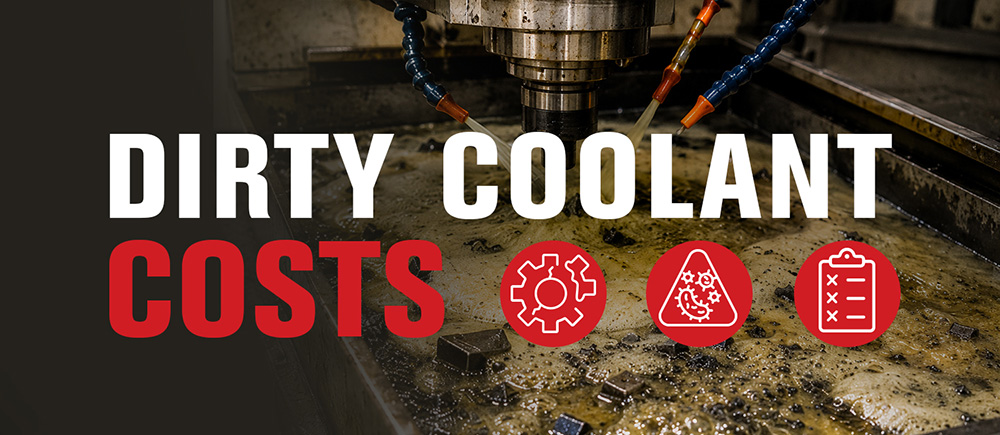
Anyone who has worked in a machine shop knows that smell. And we aren’t talking about the classic Lynyrd Skynyrd song. Rather, that sulfuric, sour smell of old coolant rising from machines that have been idle for extended periods, like over a weekend.
Unfortunately, dirty coolant brings more than just unpleasant odors to the shop.
The accumulation of tramp oils in the sump prevents oxygen from properly mixing with the fluid, creating perfect conditions for anaerobic bacteria to appear. This bacterium produces acids that can lower the coolant pH, degrading its lubricity and actually attacking instead of protecting ferrous machine parts.
That well-known, nasty smell is a telltale sign of this process occurring. Unfortunately, many operations ignore it rather than address it. If left unchecked, dirty coolant can harm more than your tools and equipment. Your staff is also exposed to several health risks and the operation can be in danger of environmental non-compliance.
What Does Contaminated Coolant Do to Tool Life?
In any metalworking application, cutting fluid (coolant) has two critical jobs:
But both functions are compromised once the coolant is contaminated with tramp oil and metal fines. The tramp oil interferes with the coolant’s ability to dissipate heat, and the fines are abrasive. When bacteria form, they consume the organic additives needed for lubrication. Once the sour smell hits the shop floor, most operations perform a sump cleanout, but by then the bacteria – and the likelihood of damage – have been building for too long, resulting in additional expenses for tool and machine maintenance.
But the opposite holds true, as well, and the numbers bear this out. Using a consistently clean cutting fluid can extend tool life by up to 25%, leading to significant annual cost savings for perishable tools.
The Danger of Hidden Damage
One of the most significant dangers that contaminated coolant brings to operations is what you don’t immediately see.
Tool wear might be the most obvious, but dirty coolant takes its toll on the entire machine environment in subtle ways that are not easily traceable to fluid quality, which is why it doesn’t often show up in a typical cost analysis.

As acids produced by bacteria lower pH levels, corrosion on ferrous metal begins to set in, usually at the cutting juncture. But unfortunately, it doesn’t stop there.
Because your pumps, sumps, spindles, coolant lines and electronic enclosures are all exposed, corrosion damage and extended wear can affect these components, too. This means these kinds of problems won’t always indicate a single-item failure. If left untreated, pumps can require early replacement, spindles can alter tolerances and filters can clog faster. When such failures occur, operators rarely trace the problem back to months-old coolant.
Beyond the coolant quality, the accumulation of abrasive metal fines in the unfiltered fluid presents another problem.
Fine particles will damage the machine cabinet window glazing and increase the wear on high-pressure pumps and components, even in filtered systems. This is because the fines can usually bypass the filters’ particle-capture ability. Effective filtration at the outset can mitigate this threat before it’s too late.

Source: Cutting Tool Engineering
Operations can further minimize the threat of damage by paying closer attention to their sumps’ capacities and performance.
Over time, chip sludge will accumulate and compact inside the sump. This can lead to some significant dangers:
In such cases, though the sump is still operational, it isn’t functioning as it should. This can damage tools, machines and products downstream.
Health Dangers to Employees
Machine and tool damage can be expensive, but exposure to workers can pose serious health risks. Studies by OSHA and NIOSH have identified several hazards related to how shops manage coolant.

Source: OSHA – Metalworking Fluids Safety and Health Best Practices
OSHA’s Metalworking Fluids Safety and Health Best Practices manual cites NIOSH research indicating that between 14% and 67% of workers exposed to metalworking fluids are at increased risk of developing dermatitis. OSHA also notes that once a person’s skin is affected by initial exposure, it becomes easier to develop further dermatitis from smaller exposures, leading to a chronic condition.
Respiratory exposure poses another significant risk. NIOSH identifies conditions such as hypersensitivity pneumonitis, chronic bronchitis, impaired lung function and occupational asthma as outcomes of exposure to metalworking fluids.
One of the most telling examples of the harmful effects of coolant exposure comes from a CDC/NIOSH Health Hazard Evaluation at an automotive engine-machining plant.
The investigation revealed that, although the facility was compliant with OSHA’s occupational exposure limits, more than half of the employees reported nasal and sinus symptoms, 31% reported respiratory symptoms and 25% reported skin symptoms.
This is significant because it shows that meeting regulatory compliance doesn’t eliminate the risk of health hazards posed by contaminated coolant.
Address the Threat Within the Structure
The fact remains that haul-away disposal doesn’t eliminate all contamination.
Hauling away spent coolant may remove the dirtiest contents from the sump, but bacteria in the chip beds, residue in the lines and tramp oil film all remain. When you then introduce fresh, clean coolant to a system with those contaminants present, the degradation process begins immediately.
The good news is that there is a way to address the issue at its core, which will keep production moving forward, improve workplace safety and help operations achieve fast ROI on equipment purchases.
By strategically using centralized coolant recycling to continuously remove tramp oil, metal fines and bacteria from the outset, operations don’t have to wait to remove degraded coolant downstream.
This results in significant long- and short-term cost savings through extended machine life, minimized workplace health hazards and improved safety in the facility.
_______________________________
The Bottom Line: Coolant Cleanliness
Effective coolant management starts with keeping your coolant clean and avoiding degradation. This can yield significant cost savings and health benefits. Whether you’re dealing with parts and equipment that wear faster, damage to finished products, or that telltale rotten smell in the shop, investing in the right CapEx equipment to run clean coolant can bring critical improvements across virtually every part of your process.
Visit prab.com to talk with our expert team about the optimal coolant management solution for your application.