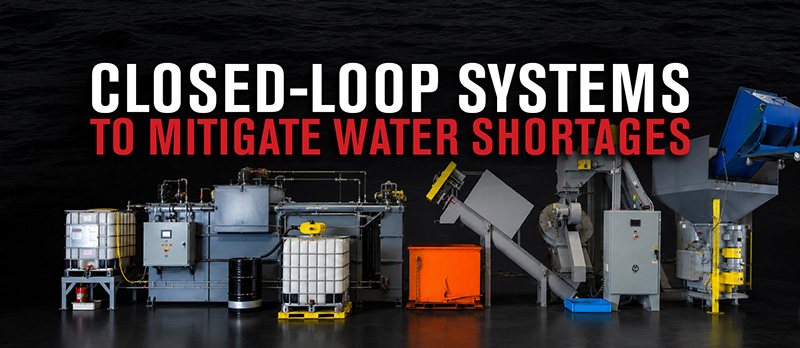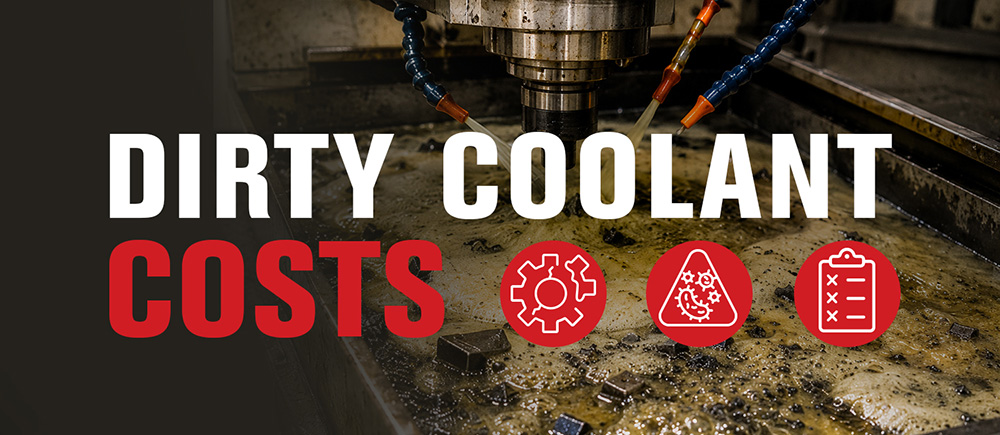

Amid rising costs, high demand and stricter environmental regulations, industrial water management has evolved into a multi-pronged challenge for metalworking manufacturers – and that’s before they decide whether to store the waste on-site or pay high haul-away fees.
This bottleneck can lead to significant financial, operational and environmental strain on an operation. Yet many manufacturers are reactive, managing their water only at certain points in the process. While such a strategy may seem cost-effective, treating mixed waste streams at the end of production might create a costlier cycle than it would appear.
In part one of our exclusive Q&A with PRAB Application Engineer, Fluid Test Lab, David Hanson, we talk about how operations can optimize their water processing, validate major CapEx equipment investments and utilize specific technologies to help manufacturers reduce costs and maintain compliance.
_______________________________
Q: What is a big challenge you’re seeing manufacturers face right now regarding their process water and wastewater management?
David Hanson: Lately, we’ve been receiving many inquiries about discharge-to-sewer applications. Perhaps the operation is increasing production, or their limits have tightened a little. Or maybe the operation changed its processes and is now finding it difficult to meet discharge limits, which is causing them to collect their waste and pay to have it hauled away. Expenses are a major driver of these inquiries, but storage is also a big factor.
Q: Is it accurate to say that treating incoming water might have a bigger impact on production, but treating wastewater may impact cost savings more? Or is the trick to accomplish both?
DH: For efficiency, you want both, preferably. But if you’re only treating it on the back end, you want to minimize the waste you produce, period. So when you look at your process, if the waste at the end is a bunch of different streams that are commingled, it makes treating it a little more difficult, depending on what you’re mixing.
Sometimes it’s easier to go back up the process to the point of generation. If oil is a problem, you treat the oil when it is generated. Or if metals are a problem, you treat the metals when they become a problem in the process.
If all those elements get mixed up in the process, you’re going to pay a lot more for a larger, more complex system. So isolating the problem at specific points in the stream can be a lot more efficient.
Q: Would an operation strategically choose to treat only incoming water instead of process or wastewater? If so, why? Wouldn’t the ideal solution be to do both to avoid complications?
DH: Ideally, operations would want to treat water at every stage. But for many applications, at least that I’ve been involved with, the waste is not a problem until it’s a problem. They discharge to the sewer or haul it away, and it’s fine. I think many companies want to establish and maintain green initiatives, but process engineers and operators tend to focus more on production.
If waste impacts production efficiency or volume, then the engineers must take time from improving the process to figure out what to do with the waste – that’s when it becomes a problem. Or, if an operation is fined for a permit violation, that’s another problem. Successful operations address issues proactively to ensure those things don’t happen.
Q: Speaking of production, and with how expensive water is becoming, how important is water reclamation to a manufacturer’s overall process in terms of improving production and better managing waste?
DH: If I were to label it, I might say it is mid-tier because volumes are important here. A smaller volume, like 10,000 gallons or less per day, with a lower flow rate, isn’t at the scale of higher flow rates, where the cost becomes much more impactful on your bottom line.
The more you produce and generate, the more waste you have. If you’re generating 50,000 gallons of waste that has to be hauled away every day, that’s going to be a lot more expensive than, say, 500. Operations with high levels of waste are typically larger, with likely greater CamEx flexibility.
Q: When it comes to CapEx purchases for coolant recycling or water treatment, how could fluid testing factor into how a manufacturer manages those assets – either to improve their process or validate the investment?
DH: Fluid testing is used primarily to verify the equipment’s functionality and performance to meet the operation’s goal. For example, when we design a system, we will show you data indicating the results you should expect from the fluid sample we tested. Then, as long as the actual feed stream to the system is based on the exact application we tested for and it is how the operation will use the equipment once it is installed, that is how to ensure it’s the right system.
This can be especially important for discharge-to-sewer applications. We can take the test results and place them side by side with your permit to verify that the system meets all of your discharge permit requirements. That gives the customer peace of mind about the investment and enables them to verify ROI based on quantifiable data.
Q: Hypothetically speaking, if you had to narrow down the most critical pieces of equipment for an operation to make optimal use of its industrial process water, what would be in your top 3?
DH: It’s really application-specific and also depends on the operation’s goals. But in most cases, it’s going to come down to tramp oil removal and then ultrafiltration and vacuum evaporation.
But it also depends on the process and the material. If solids are an issue, we’ll recommend a centrifuge or a paper bed filter. But before we know the specifics of the application, the versatile systems that can help an operation optimize its process water usage are ultrafiltration and vacuum evaporation.
Q: With water costs rising and several regions facing water shortages, what is something metalworking operations must do, or at least can do now, to help minimize costs and better manage their water resources?
DH: Start by evaluating every step of the process. Look closely at where there is potential for resource savings, such as treating incoming freshwater at the start of the process and fluid reclamation and reuse in subsequent stages. As we discussed before, going further up the process stream from the discharge point and pinpointing potential bottlenecks before multiple streams get a chance to mix can be helpful.
Flow rates are usually lower upstream. This enables an operation to apply more targeted, efficient water treatment than treating high flow rates downstream, when contamination and degradation have often set in.
Thank you, David! In a future episode, we’ll dive deeper into the crucial value of coolant recovery and reuse for metalworking operations.
For any questions or to check out the custom water treatment equipment designed to optimize your process, visit prab.com.