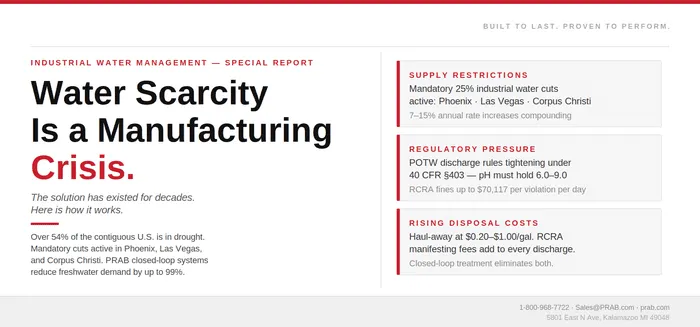
The U.S. manufacturing sector is running into a wall it cannot drill through, outsource away, or ignore any longer: water scarcity. As of early 2026, more than half of the contiguous United States is experiencing some degree of drought, and in the most production-intensive industrial regions — Phoenix, Las Vegas, Corpus Christi, San Antonio, and California’s manufacturing corridors — the situation has moved from “concerning” to “operational emergency.” Corpus Christi’s primary reservoir sat at 9% capacity in early 2026. Arizona’s semiconductor-heavy Phoenix metro faces Colorado River allocations that have already been cut. Nevada’s water stress is ranked worst in the nation in terms of economic impact. And cities across the Southwest are issuing Level 1 industrial restriction orders — mandatory 25% water use cuts that stop production lines cold.

For manufacturers who rely on water for coolant systems, parts washing, pH neutralization, surface finishing, and process fluid management, this is not a distant policy concern. It is a direct threat to production continuity — and a compliance time bomb. The good news: the technology to dramatically reduce freshwater dependency already exists, has been proven in facilities worldwide for decades, and pays for itself typically in 12 to 24 months. It is called closed-loop water management, and PRAB has been engineering and deploying these systems for more than 30 years (Process water and Industrial Wastewater Treatment. PRAB was founded in 1950).
Water stress in manufacturing does not arrive from a single direction — it converges from three simultaneously: supply restrictions (municipalities cutting industrial allocations under Level 1 drought emergency orders), cost escalation (industrial water rates rising 7–15% annually in drought-affected regions, compounding year over year), and regulatory pressure (tightening POTW discharge requirements and RCRA hazardous waste classification for wastewater with out-of-range pH). Any one of these would warrant a structural response. All three arriving together — as they are now across the Sun Belt, Southwest, and increasingly the Southeast — means that passive water management strategies are no longer viable.

PRAB anticipated this trajectory. The white paper Making Wastewater Compliance Part of a Profit Strategy identified that half the world’s population would face severe water shortages by 2050 and that regulatory pressure on industrial dischargers would accelerate, and that forecast has proven both accurate and conservative. The companion white paper Overcoming the Operational Challenges of Wastewater Regulatory Compliance details the full legal framework: the Clean Water Act, POTW pretreatment requirements under 40 CFR Part 403, and the RCRA classification that makes pH-out-of-range wastewater a categorically prohibited corrosive hazardous waste. A single untreated discharge event today can trigger EPA enforcement action and fines of up to $70,117 per violation per day.
The strategic response is not to manage that risk at the margins. It is to eliminate the discharge altogether through closed-loop industrial water management — treating process fluids on-site and returning them to production rather than sending them to the drain, the POTW, or a licensed hauler.
Closed-loop water management means freshwater intake drops sharply, discharge volumes fall toward zero, disposal costs evaporate, and compliance becomes a documented, automated outcome rather than a manual guessing game. PRAB engineers this outcome through a full, integrated technology stack:

PRAB engineers these technologies into integrated closed-loop configurations — combining pretreatment, filtration, neutralization, and polishing in a single architecture sized for each facility’s specific flow volume, contaminant chemistry, and discharge or reuse goals. Modular, skid-mounted systems scale from small operations at approximately 5 GPM to large industrial installations managing 20,000+ gallons per day. One recent PRAB customer is now reusing 81% of their total wastewater — a direct result of this systems-integrated approach.
Koss Aerospace, a Tier-1 manufacturer of aircraft components in Ontario, Canada, was discarding spent coolant at a rate of 4,000 liters per week from its 26 machining centers — incurring high haul-away costs and dealing with bacterial contamination that produced foul odors throughout the facility. After installing a PRAB Guardian™ Coolant Recycling System with Coolant Manager, Polishing Filter System, and Dirty Transfer System, Koss Aerospace achieved 75% savings on new coolant purchases almost immediately.
“We have seen around a 75% savings on new coolant purchases.” — Alexandre Blinov, Maintenance Manager, Koss Aerospace
Machine downtime for sump maintenance dropped, tool life extended due to consistently clean, properly balanced coolant, and the haul-away problem — along with its associated RCRA liability — was eliminated. The Guardian system required only connections for water, air, and power and was operational within two days of delivery.
Cameron International, a global leader in flow equipment for the oil and gas industry, operates a 32-machining center facility in Malaysia that runs 24/7. Excessive coolant purchases and bacteria-driven spoilage of coolant — accelerated by Malaysia’s humid climate — were compounding costs and threatening product quality. After installing a PRAB Guardian Coolant Recycling System with dual 800-gallon tanks and ozone injection, Cameron projected a 75% reduction in new coolant purchases and up to an 88% reduction in hazardous waste generation. Coolant was free of bacterial growth just six hours after Guardian startup.
Iowa Industrial Hydraulics installed a PRAB Guardian 400 Coolant Recycling System to resolve rising coolant costs, foul sump odors, and chronic dermatitis issues linked to contaminated cutting fluid. Coolant fluid purchase costs dropped 60%. Subsequent installation of two PRAB Universal Clarifiers and a PRAB Ultrafiltration System eliminated coolant disposal costs entirely — and simultaneously resolved a heavy metal discharge compliance issue that had previously required ongoing management.

As Youngers and Sons Manufacturing expanded, its reliance on third-party haulers to remove metal scrap and spent coolant was creating unpredictable costs and environmental liabilities. After installing a PRAB Crusher/Wringer Chip Processing System and Guardian™ Coolant Recycling System, the company replaced haul-away coolant disposal with a fully closed loop: spent sump coolant is now cleaned by the Guardian and returned to machines as recycled fluid, perpetually extending service life and eliminating both disposal cost and the fresh coolant purchase it previously required. The metal scrap that once left the facility wet — losing value and carrying RCRA liability — now leaves dry and uniform, commanding higher recycler prices.
Over the past two years, PRAB provided water and wastewater treatment solutions in 21 projects, saving customers nearly $2.6 million annually. That track record is documented and accessible. PRAB’s News & Knowledge library is one of the most comprehensive collections of industrial water management resources available from any equipment manufacturer, including:
What separates PRAB from equipment vendors is the Performantee® Guarantee — a comprehensive commitment covering process fluids evaluation, system sizing and selection, factory testing, field commissioning, operator training, and 24/7 technical phone support. PRAB also offers free process water and wastewater fluid analysis — evaluating your actual wastewater sample against the PRAB Separation Spectrum and engineering the optimal treatment configuration before any equipment commitment. The Performantee® is a process outcome guarantee: if the system does not perform as specified for your discharge or reuse requirements, PRAB makes it right. PRAB Ultrafiltration systems installed more than 30 years ago are still operating in the field today — because PRAB builds equipment to last, and backs it accordingly.
The facilities that will absorb the next decade of industrial water stress are the ones building closed-loop water management infrastructure now — before municipal restriction orders force the issue, before a POTW permit violation triggers enforcement, and before escalating water costs compress margins that are already under pressure from energy and material pricing. The manufacturers who are already operating closed-loop systems are achieving 75–90% lower disposal costs, documented compliance for every discharge event, and operational resilience to absorb a 25% water allocation cut without halting production.
PRAB has the engineering history, proven technology stack, documented case studies, and published knowledge base to be your partner in that transition. Whether your facility needs to close the coolant loop, neutralize and recirculate process water, achieve Zero Liquid Discharge, or bring your POTW compliance documentation into the automated era — PRAB engineers a solution matched to your specific chemistry, flow, and regulatory requirements, and backs it with the Performantee®.
Request a free process water and wastewater analysis from PRAB →
Explore PRAB’s full industrial water and wastewater treatment solutions →
See the Guardian Coolant Recycling System →
Explore PRAB pH Adjustment Systems →
Browse the full PRAB knowledge library: case studies, white papers, and technical briefs →
Paul Montgomery is the Marketing Manager at PRAB, Inc., a global manufacturer of engineered metal scrap handling, coolant recycling, and industrial wastewater treatment systems. With more than 30 years of experience across manufacturing, SaaS, custom development, healthcare, and education, he specializes in data-driven marketing that translates plant-floor performance into executive-level financial results. His work centers on total cost of ownership, automation integration, and closed-loop manufacturing strategies that help industrial companies reduce waste, conserve resources, and improve long-term profitability.


 (800) 968-7722
 (800) 493-3462